Evidence reviewed for this custom tracksuit sample-to-bulk case
The buyer's record contained three transaction lines marked completed: one custom hoodie and sweatpants sample, a 25-set bulk line and a 275-set bulk line. Together, the two bulk lines establish the documented 300-set order. Dated messages connect those records to fabric, decoration, fit revisions, production, packing, balance coordination and shipping.
The product direction was a dark-charcoal heavyweight pullover hoodie and matching sweatpants set. The messages identify a 420 GSM, 80% cotton and 20% polyester fabric direction, together with screen printing, embroidery and branded labels. Those details describe this buyer's reviewed project; they are not presented as a universal fabric specification, MOQ or production promise.
Buyers developing a similar set can start with our custom hoodie manufacturing and sourcing route and add a controlled sweatpants specification to the same sample record.
What the custom hoodie and sweatpants sample needed to prove
The sample was not only a color reference. It combined the hoodie, sweatpants, screen-printed artwork, embroidery, labels and fit direction in one physical set. The record shows that it was produced and delivered in December 2025, giving the buyer a physical basis for deciding whether to release bulk production.
The review also exposed points that needed correction. A front print was produced from a plate that made the result larger than expected, and the buyer questioned the centering of a hood embroidery. Instead of treating the sample as automatically approved, the parties recorded changes to garment measurements, artwork scale, embroidery placement, labels and trim details before bulk production.
Several corrections were measurable rather than subjective. That matters because instructions such as “slightly smaller” or “more centered” are difficult to inspect consistently. A revision should identify the affected component, target dimension or placement, approved artwork version and verification method.
Why the buyer moved directly from one sample to 300 sets
After the physical sample stage, the buyer confirmed the final bulk quantity at 300 matching sets across four adult sizes. The records show a straightforward commercial progression: the sample was completed, the remaining fit and decoration changes were documented, the bulk quantity was fixed and the production balance was coordinated when the goods were ready.
- Early December 2025 — sample order recordedOne custom heavyweight hoodie and sweatpants set was ordered with screen print, embroidery and label customization.
- Mid-December — sample produced and deliveredThe physical set reached the buyer's side, allowing garment, artwork and trim review before the larger commitment.
- Late December — corrections and 300-set bulk confirmedThe buyer supplied measurable changes and finalized the bulk quantity rather than extending the project through repeated speculative quotations.
- January 2026 — production and packing completedProduction updates, packing information and the remaining balance were coordinated before shipment release.
- January — first 25 sets deliveredThe buyer confirmed receipt of the urgent group and thanked the seller for the timely service.
- Later follow-up — new development discussions continuedSubsequent garment discussions show an active relationship, but they are not counted as another completed order.
The direct conversion is useful trust evidence because it is supported by completed transaction records rather than an unverified sales claim. It does not prove that every sample should convert at the same speed; the buyer had a clear product direction and responded quickly when decisions were ready.
Split shipping: 25 urgent sets and 275 planned sets
The 300-set program was divided into two order and shipping groups. Twenty-five sets were prioritized for the faster route, while the remaining 275 sets were planned for sea transport. The first 25 sets have direct buyer delivery confirmation. The larger group's dispatch and tracking coordination are visible, and its transaction record is marked completed.
The reviewed conversation does not include an equally explicit buyer message confirming physical receipt of all 275 sets. For that reason, this case does not say that all 300 sets were confirmed delivered. Completed order status, dispatch evidence and buyer-confirmed receipt are different proof levels and should remain separate.
For apparel buyers, this is also a planning model. A small urgent batch can support an event, launch or early stock requirement, while a larger planned batch uses a slower route. The packing list should make the two groups independently traceable, and the quotation should state route, delivery scope, estimated transit and destination responsibilities for each group.
What the buyer found when inspecting the first 25 sets
After receiving and checking the urgent group, the buyer reported loose threads, some labels that were not fully secured on selected sweatpants sizes and an embroidery-position issue on part of one hoodie size. The buyer also said that the order was otherwise very good. The supplier acknowledged the feedback for future production.
This feedback is included because a credible apparel bulk order case should not turn an inspection into a perfect-score testimonial. It shows which controls need strengthening: thread trimming, label-seam security and decoration placement by size. The available evidence does not support claiming that the already packed larger group was reworked after this feedback, so no such claim is made.
Quality controls for a custom sweatsuit bulk order
A sample-to-bulk clothing production workflow needs checkpoints that survive the jump from one set to hundreds. The following controls are directly relevant to this documented custom sweatsuit order.
- Use one revision sheet for hoodie and sweatpants measurements so the set remains coordinated
- Record fabric composition and weight direction, color reference and approved hand feel
- Control the screen-print master, finished print dimensions and placement from fixed garment points
- Use an embroidery placement template and recheck alignment across every ordered size
- Define label position, stitch coverage and pull-check method before bulk sewing
- Compare a pre-production or size-set sample against every measurable correction
- Add thread trimming and label security to in-line and final workmanship checks
- Identify the 25-set and 275-set packing groups separately on controlled packing records
- Treat the first urgent shipment as evidence, not automatic acceptance of unseen quantities
- Record buyer feedback by defect type, size and next-order corrective action
Use the pre-production sample approval checklist to lock revisions and the garment quality control checklist to plan inspection evidence.
What this 300-set custom tracksuit case proves
The strongest outcome is the buyer's behavior: a physical sample was completed, specific corrections were recorded and the buyer then committed to 300 sets without a prolonged intermediate order. Production and split-shipping records followed, the first 25 sets reached the buyer and the relationship continued into later product discussions.
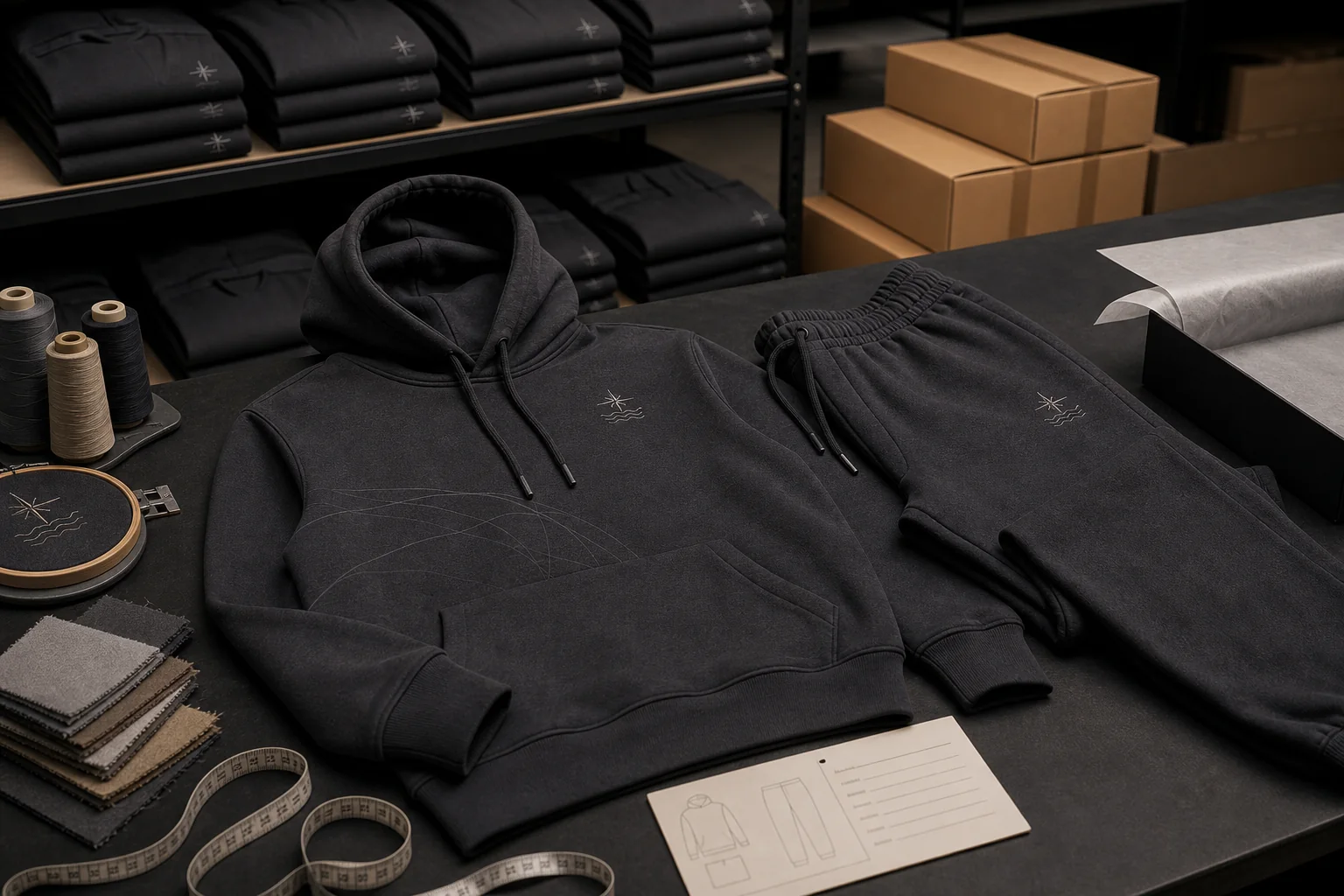
The public image reconstructs the product and approval workflow with an original charcoal set, abstract decoration, QC tools and grouped cartons. It does not reproduce the buyer's actual artwork, labels, documents or delivered-product photographs.
Evidence boundaries buyers should understand
- Three transaction lines were marked completed: one sample, 25 bulk sets and 275 bulk sets
- The two bulk records total 300 hoodie and sweatpants sets
- The reviewed fabric direction was 420 GSM and an 80/20 cotton-polyester blend
- Screen print, embroidery and custom labels were included in the sample-to-bulk workflow
- The buyer confirmed receipt of the first 25 sets and provided detailed inspection feedback
- The remaining 275-set record shows dispatch coordination and completed status, not an explicit buyer receipt message
- The case does not establish a universal MOQ, price, lead time or delivery result
- Later development conversations are not counted as additional completed orders