Repeat custom hoodie order evidence reviewed for this case
The buyer's order panel contained nine dated order records from late 2023 through early 2026. Six were explicitly marked completed and three were closed. Only the completed records are counted in this case. The quantity fields on those completed lines total more than 1,700 pieces, including samples, larger custom hoodie runs and a later add-on order.
Dated 2025 messages add a second layer of evidence: artwork and color review, a completed six-design sample-order card, production updates, payment coordination, a pre-production correction, bulk progress, packing information and split-shipment planning. Because the hoodie record is the most continuous product thread, this page does not use the buyer's separate shirt development work to inflate the hoodie result.
Buyers planning a similar program can review our custom hoodie manufacturing and sourcing route. The quantities in this case are historical evidence, not a universal MOQ or capacity promise.
From custom hoodie samples to repeat bulk production
A repeat order is strongest as trust evidence when its stages can be separated. In this case, the record does not show one isolated transaction described as a partnership. It shows completed hoodie orders over multiple years, followed by a later multi-design development program and an additional completed order.
- Late 2023 — first completed bulk recordA completed custom hoodie order line covered more than 300 pieces. A separate record from the same period was closed and is not counted.
- Early 2024 — sample plus larger completed linesThe panel records one completed sample line and two completed hoodie lines in the mid-hundreds, establishing repeat purchasing rather than a single trial.
- October 2025 — six-design sample stageA completed sample-order card and dated messages show six design directions, color review, print-detail discussion and physical sample shipping before the larger program.
- November 2025 — sample correction before bulkTwo sample units were reported with the wrong front artwork file. The issue was disclosed, the bulk correction was stated and the buyer then continued with the program after the pre-production review.
- December 2025 — multi-design bulk and split deliveryProduction, packing, balance-payment and freight messages document a large hoodie program. One dated shipping update records more than 2,000 hoodies in the second sea-shipment batch.
- January 2026 — urgent add-on orderA separate completed order covered approximately 120 additional hoodies, with different delivery priorities discussed for two program groups.
Later follow-up messages show that the commercial relationship remained active. They are not presented as another completed order because no later completed transaction was visible in the reviewed record.
Why the disclosed sample-file mistake strengthens the evidence
During the sample stage, the seller stated that two hoodies had been produced using the wrong front artwork file. The message did not hide the issue or describe the samples as fully correct. It said the bulk production would be adjusted. Subsequent messages show the buyer approving the pre-production direction and the bulk program continuing.
This case does not claim that mistakes are desirable. It shows why a sample-to-bulk workflow needs a correction gate. The disclosed issue was limited to the sample stage in the available record; the evidence does not support claiming that every later unit was individually inspected.
Split sea and air shipping for a multi-design hoodie program
The buyer had both large planned quantities and event-driven delivery needs. Messages therefore discussed sea freight for the larger program and faster air or express routes for urgent quantities. The buyer also challenged a higher freight cost, after which another sea-shipping option with a longer estimated transit window was reviewed.
This is a practical wholesale trade-off: the fastest route is not automatically the best route for every carton. A split-shipment plan can reserve air freight for event-critical units while moving planned bulk by sea, but production completion, carton volume, customs scope, destination handling and the required arrival date must be written into the decision.
The buyer later asked how different program groups and sizes were packed and identified. Those questions expose a useful control for future orders: every carton should carry an external, privacy-safe code that maps to the approved design group, color and size quantities on the packing list.
Controls for repeat and multi-design custom hoodie orders
Repeat orders reduce some development uncertainty, but they create version-control risk when artwork, quantities, colors or delivery dates change. The following controls are relevant to the documented case.
- Create one SKU or variant code for every approved garment-color and artwork combination
- Keep the approved front, back, sleeve and pocket files under the same revision record
- Confirm whether print treatments require decoration before or after sewing
- Approve a physical sample or pre-production sample before releasing bulk printing
- Record the size breakdown separately for each design group
- Use an external carton code linked to the packing list instead of relying on memory or visible artwork
- Separate event-critical air quantities from planned sea-freight quantities before quoting delivery
- Reconfirm freight cost and estimated transit when volume or route changes
- Close each shipment only after tracking and buyer receipt are reconciled
Our pre-production sample checklist and international apparel shipping guide provide more detailed planning questions.
What multi-year repeat purchasing proves about buyer trust
This case does not rely on a generic testimonial. Its trust signal comes from buyer behavior recorded over time: completed transactions in more than one year, larger completed quantity lines after earlier orders, a six-design sample program, continued bulk production after an openly discussed correction and a later urgent add-on order.
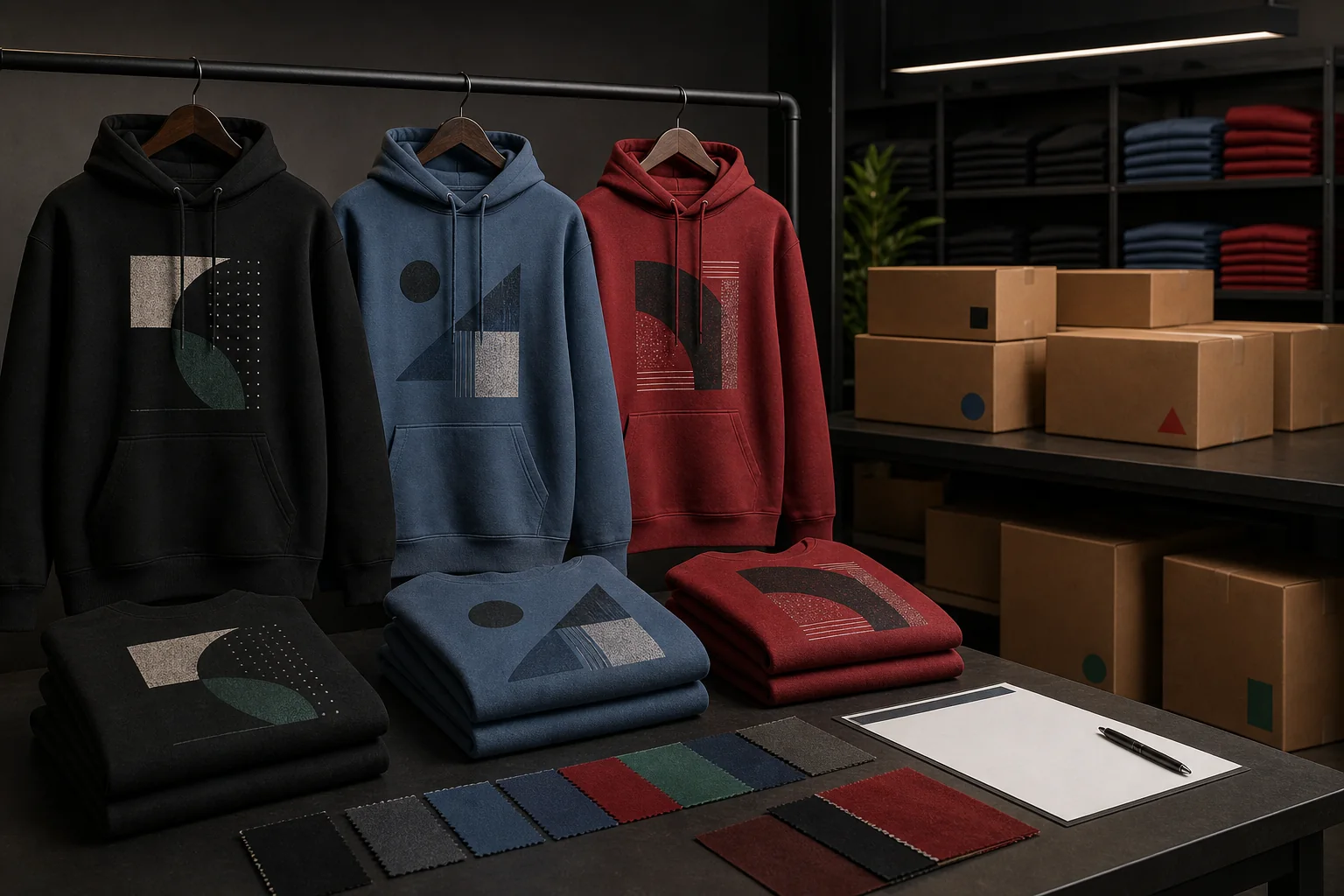
The public image reconstructs that operational pattern with multiple original hoodie graphics, sample swatches and grouped cartons. It does not reproduce the buyer's designs, project names, delivery photographs or documents.
What this repeat hoodie case proves — and what it does not
- The reviewed panel showed nine order records, six completed and three closed
- The completed records span more than two years and exceed 1,700 pieces in total line quantities
- A later completed sample card covered six hoodie design directions
- A sample artwork-file issue was disclosed before the bulk program continued
- A dated message recorded more than 2,000 hoodies in a second sea-shipment batch
- A separate completed add-on order covered approximately 120 hoodies
- Closed orders are not counted as completed revenue or production
- The case does not establish a standard MOQ, price, lead time, fabric or print specification
- It does not claim that every quoted or discussed quantity became a completed order