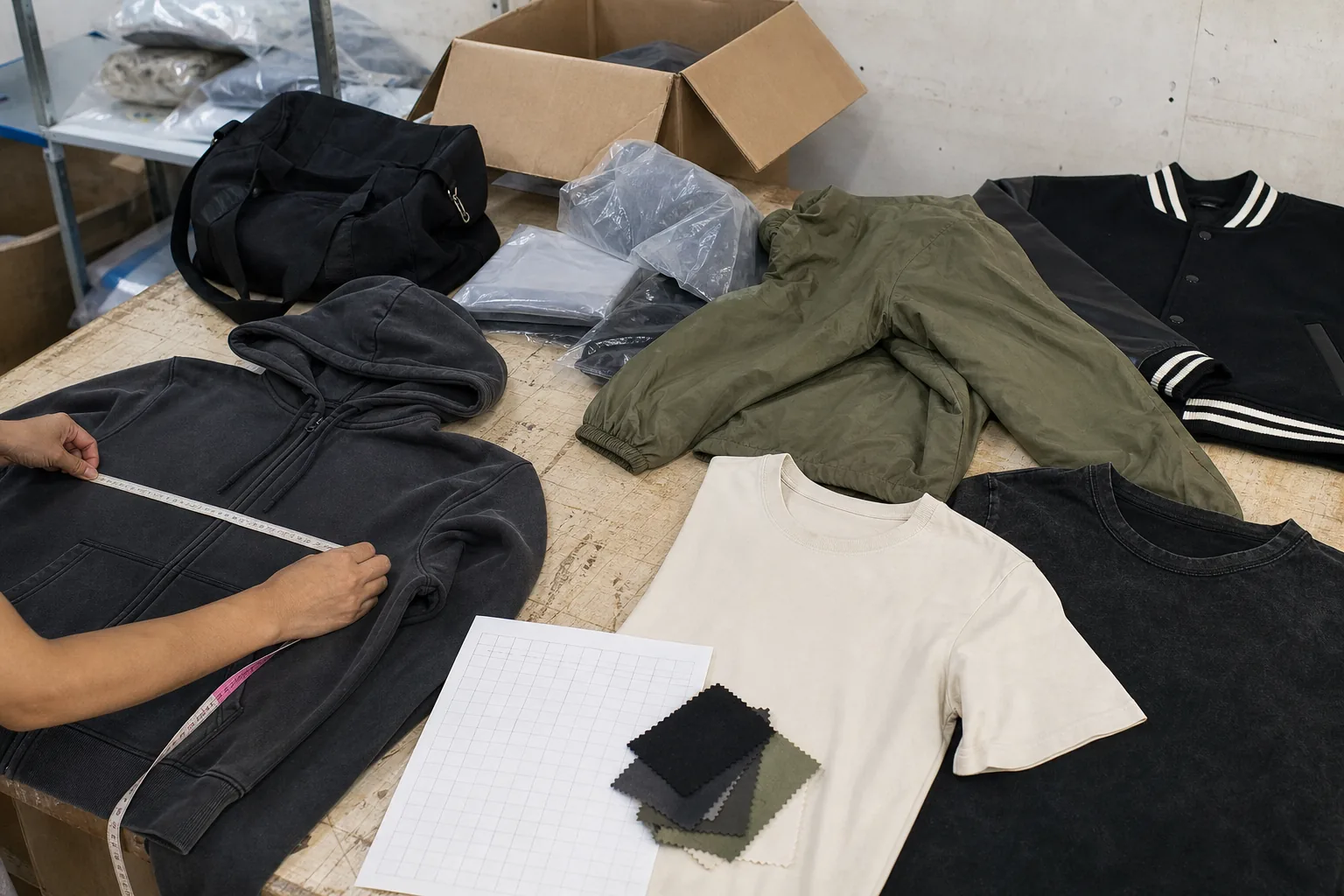
What was verified in this long-term apparel buyer case
The reviewed history contains more than friendly conversation. It includes dated delivery follow-up, explicit paid-sample records and several distinct order cards marked completed. A January 2026 record covered two samples, a March record covered five products, and a May record covered six products. Repeated copies of the same modified order card were counted once rather than presented as separate transactions.
The earlier messages also document a bulk shipment signed for in May 2025 and a windbreaker signed for in April. Later messages show a custom hoodie restock, a 359-piece quantity confirmation, a paid sports-bag order awaiting shipment and a varsity-jacket invoice still moving through confirmation. Those later statuses are not described as completed.
The records support a durable buyer relationship and repeated project activity. They do not establish a universal order value, standard lead time, guaranteed reorder rate or lifetime customer total.
From delivered bulk work to repeat custom streetwear orders
The value of this case is the progression. The buyer did not simply place one order and disappear; the documented project scope changed as confidence, product needs and approval decisions evolved.
- April to May 2025 — delivery evidenceMessages confirm a windbreaker was signed for and a larger shipment later reached the buyer. A separate four-product record was still awaiting the final balance, so it is not counted as a completed record.
- May to August 2025 — correction and hoodie restockThe buyer raised a decoration concern, then returned with a hoodie restock and a corrected no-front-seam direction. Color, front treatment and large back-art placement were discussed before the next version.
- January 2026 — paid multi-product samplesA two-product order was explicitly marked completed and described as two samples. The buyer confirmed payment before sending the next private artwork.
- March to May 2026 — larger multi-product workA five-product order was marked completed after several documented modifications. A dated message later confirmed a total quantity of 359 pieces, and a separate six-product record was also marked completed.
- June to July 2026 — category expansionThe active program expanded to a sports bag and a varsity-style jacket. The sports-bag record showed payment and awaited shipment. The jacket had an invoice request and buyer payment message, while the visible card still showed confirmation pending; this case therefore keeps it active rather than completed.
Why the buyer kept returning to the same custom clothing partner
The messages show three trust signals that are more useful than a generic testimonial. First, the buyer returned after delivery and after long gaps in communication. Second, the buyer asked to restock an earlier hoodie rather than restart the supplier search. Third, the relationship expanded from hoodies and outerwear into T-shirts, a sports bag, a varsity jacket and multi-product orders.
Long-term retention did not require pretending every project was perfect. A 2025 exchange shows that one decoration direction was not fully aligned with the buyer's intended version. The response acknowledged that the finished treatment could not simply be removed and discussed a new-batch route. The later restock and new orders are stronger trust evidence because they occurred after a difficult product conversation, not only after praise.
How to control repeat orders across hoodies, T-shirts and outerwear
Repeat custom streetwear production becomes risky when the team assumes an old approval applies to a new product. A hoodie restock may reuse an approved base, while a windbreaker, T-shirt, sports bag or varsity jacket needs a different construction and decoration review.
- Identify whether the project is an exact reorder, a revised reorder or a new development
- Freeze the approved garment silhouette, fabric, color and finished measurements by version
- Keep front, back and sleeve artwork dimensions in one controlled placement sheet
- Confirm whether seams, panels or pockets affect the intended decoration
- Approve the correct sample when fit, fabric, product category or artwork changes
- Separate sample, bulk, balance-due, paid-in-production and completed order statuses
- Use category-specific inspection points for hoodies, T-shirts, outerwear and accessories
- Reconfirm packing, freight route and destination requirements before each release
Buyers can prepare the approval record with our pre-production sample checklist, then compare production controls in the clothing manufacturer evaluation guide.
What this case shows buyers searching for a streetwear manufacturer
A credible long-term custom clothing partner should be able to distinguish an exact reorder from a design change, coordinate more than one garment category and show what stage each project has actually reached. This case supports those capabilities through dated repeat-order behavior and completed records, not through an unsupported claim that every discussion became bulk production.
For category-specific planning, review our custom hoodie manufacturing guide and custom T-shirt manufacturing guide. Buyers expanding from one garment into a wider collection should keep one master project brief while maintaining separate technical and approval records for each style.
What this repeat-buyer case proves — and what it does not
- Reviewed buyer and order evidence spans at least April 2025 through July 2026
- Delivery messages confirm earlier windbreaker and bulk-shipment receipt
- A paid two-product sample order was marked completed
- Distinct five-product and six-product records were marked completed
- A dated message separately confirmed a 359-piece project quantity
- The buyer returned for a hoodie restock and additional product development
- The paid sports-bag order is described as awaiting shipment, not completed
- The varsity-jacket project is described as active because the visible status evidence was not fully aligned
- The case does not disclose or imply total customer value, standard pricing or guaranteed performance