How should a clothing brand approve color?
Agree on a reference that both sides can identify, review the proposed color on the intended material, compare components that will be worn together, and record the scope of each approval. Keep the approved reference available when the production material is checked. A message saying “the navy looks good” leaves too much unresolved if the hoodie body, rib and matching trousers come from different materials or sources.
This guide focuses on color decisions for a clothing order. For material composition, construction, weight and sourcing routes, start with the fabric sourcing guide. Those requirements still matter even when the shade is right.
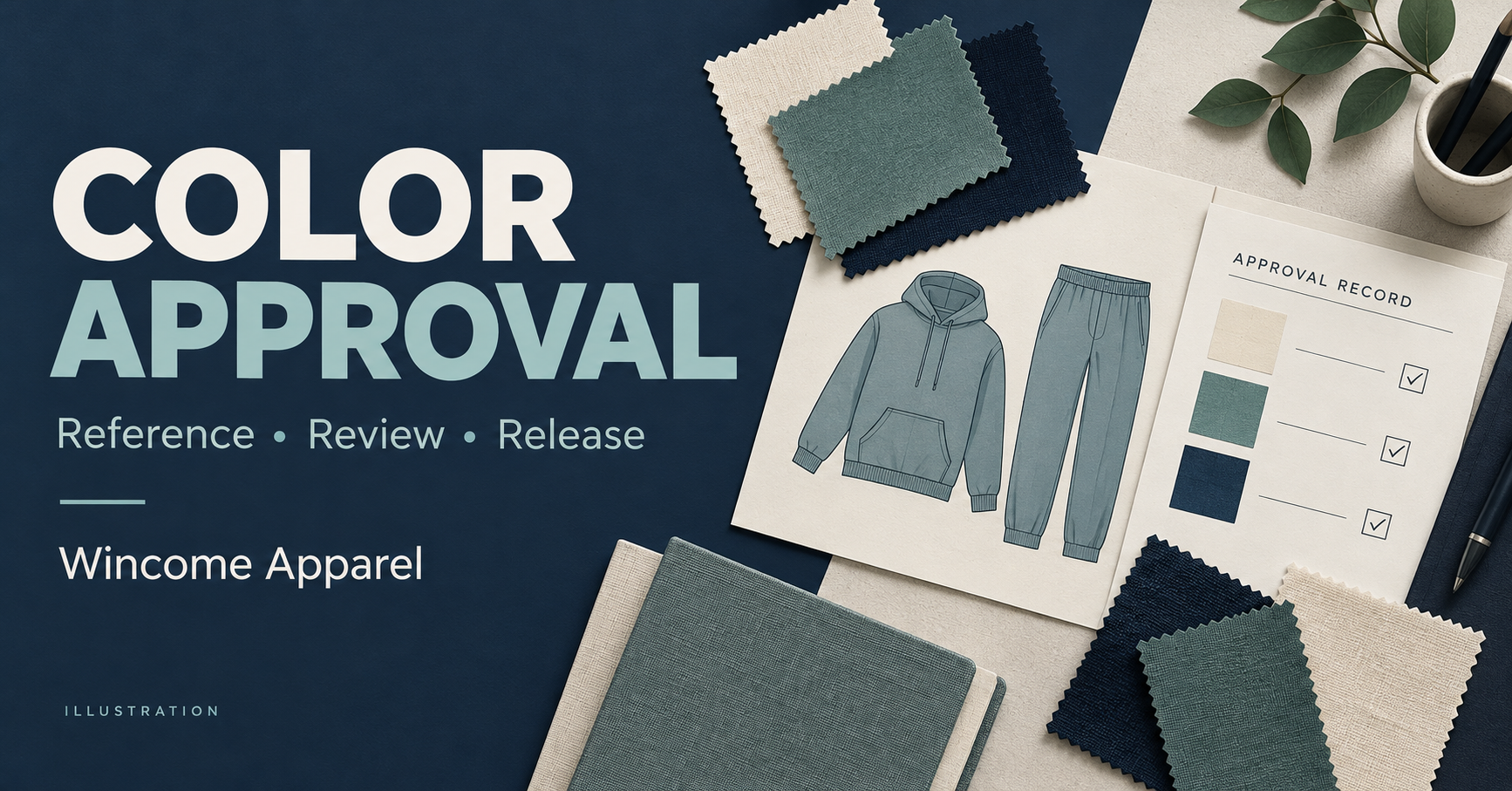
1. Name the color system, not just the number
Pantone TCX references are dyed cotton standards used for fashion and soft goods. TPG references are lacquered coatings on paper, primarily used for hard goods and coatings. In the graphics system, C and U refer to coated and uncoated paper. Include the full system and suffix in the brief; do not assume a number taken from a logo file is automatically the agreed reference for dyed fabric. Pantone guidance on the two systems and their material formats; Pantone numbering explained.
For a printed logo, ask the decorator which reference they can work from and approve the result on the actual garment material. For a dyed body fabric, agree with the material supplier which physical or controlled digital standard will be used. A cotton reference may be useful for a cotton program, but it is not a promise of identical appearance on every fiber or finish.
In this guide, a controlled digital standard means identified measurement data, such as spectral reflectance data, shared with agreed measurement conditions and a reference version. It does not mean the color shown by a HEX value or screenshot. Confirm that the parties receiving the data can use the agreed format. Datacolor guidance on digital color communication.
A HEX value or screenshot can communicate an initial direction. It should not silently become the final physical standard. Pantone itself notes that screen simulations may differ from its physical standards. Pantone Color Finder notice.
If you do not have the requested reference, ask the supplier to propose clearly identified physical options. Approve one with a reference ID and retain matching records on both sides. An online conversion may help shortlist a direction; the approval still needs to identify what was actually reviewed.
2. Define what your lab dip or fabric approval covers
Use two fields in the approval record: target reference and accepted submission. The target could be an agreed textile color standard or a retained physical reference. The accepted submission is the particular fabric, lab dip or decoration sample the buyer reviewed. If the accepted result differs from the original target, write down whether that difference is accepted for this item and order.
For custom dyeing, a lab dip is a proposed small-scale shade submission. For an available fabric, the relevant evidence may be an identified swatch from the offered lot. A print strike-off concerns the print on its defined material. None of these names should be treated as permission to proceed with every later production step.
Ask a concrete question: “Does this approval allow color development to continue, allow the bulk material run, or release this identified material for cutting?” Put any remaining checks beside the decision. The pre-production sample checklist covers the wider garment approval.
REFERENCE → REVIEW → RELEASE
Four decisions. A recorded scope at every step.
Agree reference
System/code or reference ID; material and version.
Review submission
Lab dip, stock-lot swatch or print sample; scope and decision.
Check components
Body, rib, trim and companion garment reviewed together.
Approve identified bulk lot
Lot evidence, decision owner/date and the exact next step.
Open issue? Return to the relevant review stage. One item's approval does not release the other components or the whole shipment.
3. Approve the components as a group
A matching set needs a shared reference across its parts. List the hoodie body, pocket, rib, drawcord and trousers separately if they use different materials or supply routes. Include the logo or trim when its relationship to the garment color is important. Define whether the design requires a close match, a deliberately tonal difference or a contrast.
Review the proposed components together rather than accepting isolated photographs from separate suppliers. Two samples can appear to match under one light and differ under another; this is called metamerism. X-Rite describes the issue particularly in products assembled from different materials. X-Rite explanation of metamerism.
Agree on the lighting used for the decision and any additional viewing condition relevant to the intended product. If the brand cannot make a reliable assessment, ask the supplier or an appropriate color specialist to define the evaluation. This is more useful than arguing over phone images taken in different rooms.
Datacolor's guidance similarly stresses aligned references, clear responsibility and a color standard suited to the material. These are planning principles, not evidence that a specific supplier has a light booth, laboratory or instrument. Confirm the actual evaluation capability and scope for the order. Datacolor color-program guidance.
4. Make the acceptance rule usable
A buyer can request visual assessment, instrumental assessment, or an agreed combination. State who reviews the evidence and how a disagreement is resolved before the order reaches the release point. A photograph can document which sample was discussed; it cannot show another person exactly how that sample looked under the agreed light.
If an instrument report is required, identify the color-difference formula, reference, measurement conditions and agreed acceptance requirement. A bare “Delta E passed” is incomplete. CIELAB and CIEDE2000 difference values are not directly interchangeable, so a number without the calculation method cannot be compared reliably with another report. Datacolor explanation of color-difference formulas.
For each submission, record whether you reviewed the material before or after the intended production finish. Keep approval of its present shade separate from colorfastness performance. For example, ISO 105-C06 addresses resistance to domestic and commercial laundering; a visual color match does not establish that test result. Agree the relevant method and requirement separately for the product. ISO 105-C06 public scope.
Do not copy a universal pass number into the order. Have the buyer and relevant technical party agree a requirement appropriate to the material, appearance and use. If a component is intentionally darker, record that separately rather than treating it as an unexplained exception.
5. Check bulk fabric color against the approved reference
Before cutting, identify which production material is represented by the submitted evidence. Ask for the fabric code, color, lot or other traceable production identifier, the reference used for comparison, and the review result. If the order includes more than one lot, make the scope visible instead of allowing one approved fabric cutting to stand for unexamined material.
Where acceptable shade groups are proposed, request an agreed plan for keeping garment panels and matching-set components together. The sampling and grouping method should be agreed with the production or inspection team. A checked swatch is evidence for its stated scope, not a claim that every roll or finished garment was examined.
If the material, finish, component source or reference changes, pause the affected approval and decide what needs to be reviewed again. Keep the earlier accepted sample rather than replacing it without a revision record. For a reorder, specify whether the previous reference remains the target and request current evidence; the old invoice alone does not approve a new lot.
Example: one navy set, three separate decisions
This is an invented planning example, not a Wincome customer order, measured result or default production procedure.
On a small screen, scroll the table to read all three columns.
| Component | Evidence presented | Recorded decision |
|---|---|---|
| Hoodie and trouser body | Identified proposed fabric submission compared with the shared target | Development shade accepted; production-lot comparison still required |
| Cuff and waistband rib | Rib sample shown beside the accepted body material | Hold this component for another comparison under the agreed lighting |
| Drawcord | Physical trim option reviewed with body and rib | Proposed darker tone requires the buyer's explicit design decision |
The body approval does not release the rib or drawcord. The buyer records who must respond, what evidence is missing and which next action remains blocked. Once the combined appearance is accepted, the record identifies that specific combination.
A color-approval record to send with your brief
The following is an original working template. Complete it with the production team; it does not prescribe a test standard or replace the purchase agreement.
Project / style / colorway: [identify each]
Components that must coordinate: [body, rib, trim, decoration, companion garment]
Target reference: [system + full code/suffix, or agreed reference ID]
Physical reference holders: [buyer / supplier / reviewer and copy identification]
Material and finish: [fabric code, composition, construction, intended finish and stage reviewed]
Submission being reviewed: [ID, revision, date, component and lot scope if applicable]
Comparison conditions: [agreed lighting and assessment method]
Acceptance requirement: [visual/instrumental rule and authorized reviewer]
Decision: [accepted / hold / resubmit; accepted differences; approver and decision date]
Action authorized: [specific next production step and covered material]
Open conditions: [owner, required evidence and review date]
Bulk / reorder check: [reference retained, lot evidence and reapproval triggers]
Questions buyers ask
Can I send a HEX code to a clothing manufacturer?
Yes, as an initial design direction. Agree on the physical or controlled color standard and the material submission used for approval before treating that direction as a production requirement.
Does one Pantone number make fabric, rib and print identical?
No. Specify the full system and evaluate the actual components together. Agree how close they need to match, or whether a tonal or contrasting relationship is intentional.
Does an approved lab dip approve the bulk fabric?
It approves the submission and scope written in the record. Keep a separate decision for the identified production material and any outstanding component checks.
What if the supplier and I disagree about the color?
First confirm that both sides are comparing the same reference, submission and conditions. Request the missing evidence and keep the affected decision open. Record any resubmission or accepted difference before allowing the next step.