Do clothing manufacturers source fabric?
Many clothing manufacturers coordinate fabric sourcing, but the route varies by supplier and program. A production partner may offer an available material, source an existing mill construction, arrange a custom color or finish, coordinate a custom knit or weave, or accept a buyer-nominated material. These are different commercial and approval routes, not interchangeable meanings of "we provide fabric."
Buyers should define the intended garment and material requirements, approve physical evidence and identify the bulk production reference before irreversible cutting. Do not assume that a garment facility owns a mill, holds every fabric in stock or can reproduce a reference from a photo alone.
Know who is responsible for each fabric decision
"The manufacturer" may describe a garment facility, a sourcing and production partner, or a vertically integrated operation. Ask which entity performs each step instead of assuming one company controls the full textile chain.
| Role | Typical decision | Buyer question |
|---|---|---|
| Garment manufacturer | Consumption, cutting, sewing, garment sample and production use | Will the sample and bulk order use the same approved material reference? |
| Sourcing or production partner | Supplier coordination, commercial handoff and approval tracking | Who records the fabric code, open points and final approval? |
| Mill | Knit or woven construction, yarn and fabric production | Is this an existing construction or a new development? |
| Dyeing, printing or finishing partner | Color, print or functional/surface finish | Which approval applies before the production run? |
| Distributor or stock program | Available qualities, colors and lots | What is available, reservable and repeatable for a reorder? |
| Buyer-nominated source | Material selected or supplied by the buyer | Who owns receiving checks, shortages, replacement and delay risk? |
A vertically integrated supplier may combine several roles. That can change coordination, but it does not remove the need for a written specification, physical approval and responsibility record.
Define the fabric before asking for a price
A useful request describes performance and construction, not only a marketing phrase such as "premium cotton." If some decisions are open, label them as targets or acceptable ranges rather than inventing a fixed specification.
- Garment type, target customer and intended use
- Fiber composition or acceptable blend range
- Knit or weave structure
- Target finished GSM or other mass-per-area requirement
- Surface, drape and hand-feel direction
- Stretch and recovery requirement where relevant
- Finish, wash, print or performance requirement
- Physical color reference and approval method
- Quantity by style and color
- Destination-market or buyer test requirement
- Whether substitutions are allowed and who approves them
Use the clothing GSM guide to define fabric weight and the apparel tech pack guide to place the approved material into the BOM and revision record. For hoodies, the French terry vs fleece guide explains why a fabric name alone does not define composition, weight or finish.
Compare four fabric sourcing routes
| Route | Usually helps when | Main trade-off | Buyer approval focus |
|---|---|---|---|
| Available or stock quality | A lower-volume pilot or faster development needs an existing option | Colors, specifications, current lot and reorder continuity can be limited | Exact fabric code, current availability, lot identity and continuity plan |
| Existing construction with custom color or finish | The base material works but the brand needs a differentiated shade or finish | Dyeing or finishing minimums and approvals may control quantity and timing | Lab dip or finish trial, intended test method and bulk-lot comparison |
| Custom-developed knit or woven fabric | The material specification is central and the program supports development | More development, a longer dependency chain and separate material minimums | Yarn and construction specification, sample yardage, testing and repeatability |
| Buyer-nominated or buyer-supplied fabric | The buyer already controls a material source or licensed quality | Freight, receiving, usable width, shortage and liability must be assigned | Supplier code, receiving inspection, shade/lot, replacement and waste responsibility |
Why fabric MOQ can control clothing MOQ
The garment facility's sewing minimum and the textile supply chain's run minimum can be separate constraints. An available fabric may have a small release quantity but limited colors. A custom color, print, knit or finish may require a production lot larger than the number of garments planned for one style.
| Constraint to ask about | What it controls | What to record |
|---|---|---|
| Garment MOQ per style | Pattern, setup and sewing route | Styles included and whether they can share construction |
| Garment MOQ per color | Cutting, bundling and production efficiency | Color allocation and size breakdown |
| Available-fabric minimum | Release quantity from a current lot or stock program | Fabric code, lot, usable width and availability date |
| Custom-color or finish minimum | Dyeing, printing or finishing run | Color/finish approval, unit of measure and surplus treatment |
| Custom knit or weave minimum | Yarn, machine and fabric production setup | Construction, total material quantity and development scope |
Ask whether several styles can share one approved fabric lot, whether a surcharge is available, what happens to excess material and who owns leftover fabric. The clothing manufacturer MOQ guide retains the complete small-batch order-planning framework; this page addresses only the fabric layer.
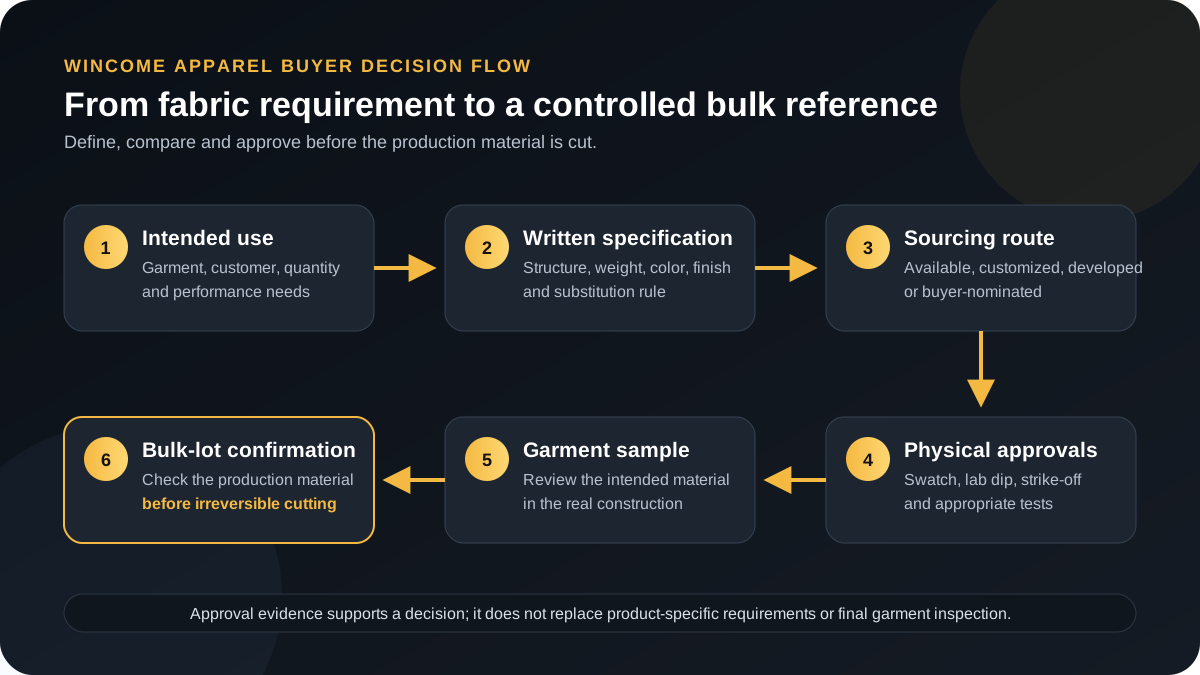
Move from a reference to an approved production fabric
- Define the intended use. Record the garment, customer, performance needs and quantity/color plan.
- Write the fabric requirement. Separate required properties, acceptable alternatives and open questions.
- Select the sourcing route. Identify whether the candidate is available, customized, newly developed or buyer-nominated.
- Review a physical candidate. Record the fabric code, source route, lot where applicable and which requirements the swatch is intended to meet.
- Approve color or print evidence. Use a lab dip for a proposed custom dye shade and a strike-off for a proposed print where those steps apply.
- Review sample yardage or a garment sample. Check how the intended material behaves in the real construction.
- Complete appropriate testing. Name the method, condition and acceptance requirement instead of writing only "wash tested."
- Lock the dated reference. Keep the approved fabric code, swatch, color/print approval, sample and specification revision together.
- Confirm the bulk lot before cutting. Assign responsibility for shade, lot, specification and test review before the material becomes irreversible work in progress.
Connect garment fit and construction decisions to the clothing sample development process. A fabric approval does not replace garment sample approval, and a garment sample does not automatically prove that an uncontrolled bulk lot matches.
Understand what each fabric approval can prove
| Evidence | What it can help prove | What it does not prove alone |
|---|---|---|
| Photo or video | Visual direction and initial shortlisting | Accurate color, hand feel, weight or performance |
| Swatch or hanger | Physical surface, approximate hand feel and a candidate color | Full-garment drape, laundering behavior or bulk-lot consistency |
| Lab dip | A proposed custom dye shade against an agreed reference | Finished garment performance or bulk shade consistency by itself |
| Print strike-off | Print color, scale and clarity on a defined material | Complete garment placement or full production consistency |
| Garment sample | Material behavior in the intended construction and fit | Automatic proof that bulk fabric and production will match |
| Bulk-lot or roll confirmation | Identity and evidence for the actual production material | Finished garment workmanship, measurements or packing conformity |
Choose fabric tests for the product and decision
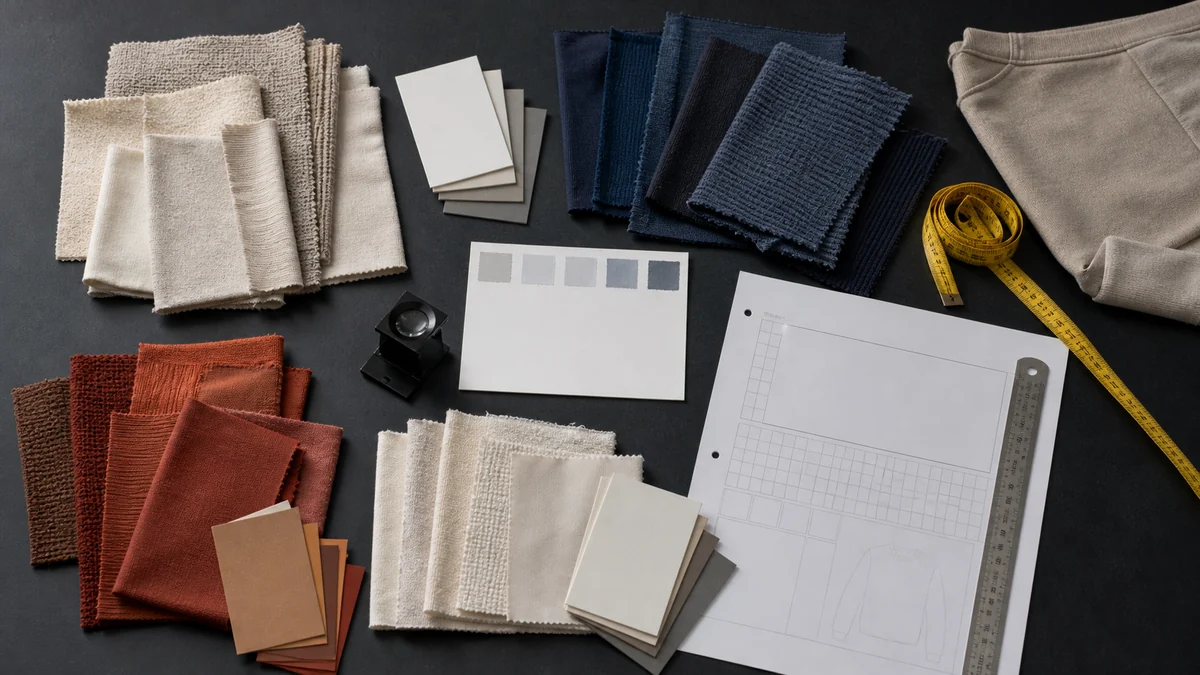
Testing scope depends on the fabric, garment use, destination, buyer requirements and failure risk. Possible checks include mass per unit area, dimensional change after laundering, colorfastness, rubbing/crocking, pilling, stretch and recovery, spirality or skew, and product-specific performance tests. The method and acceptance level should be named; a list of test words is not a specification.
- ISO 6330:2021 specifies domestic washing and drying procedures used in textile testing.
- ISO 105-C06:2010, confirmed current by ISO in 2026, covers methods for colour fastness to domestic and commercial laundering.
- ASTM D3776/D3776M-20(2025) covers mass per unit area (fabric weight) measurement.
These links explain method boundaries; they do not show that a material, supplier or garment is certified or compliant. Select the applicable method and pass/fail requirement with the buyer's technical or compliance team.
Fabric sourcing warning signs
- The quote relies on a vague phrase such as "premium cotton" without a measurable material record
- The supplier cannot identify which buyer requirement a proposed swatch is intended to meet
- Photos or digital color values are treated as final physical approval
- Fabric, dye-lot and garment minimums are combined into one unexplained number
- Substitutions can occur without an agreed buyer approval rule
- The garment sample uses a substitute material without clear labeling
- Bulk cutting can start before the agreed fabric approval evidence is complete
- Sustainability or certification claims cannot be connected to applicable documents
For environmental or certification language, use the sustainable apparel sourcing and claims guide. Availability and scope must be verified for the actual facility, material and order.
Buyer checklist before approving fabric
- Fabric code and sourcing route recorded
- Composition and knit/weave structure recorded
- Finished weight or other material specification recorded
- Approved physical color reference recorded
- Intended finish, wash or print recorded
- Material, color and garment minimums separated
- Surplus and leftover-material treatment confirmed
- Lead-time dependencies identified without an unsupported guarantee
- Required tests, methods and acceptance criteria named
- Swatch, lab dip or strike-off status recorded where applicable
- Garment sample made in the intended material
- Approved reference dated and retained
- Substitution and reapproval rule documented
- Bulk-lot confirmation responsibility assigned before cutting
Use the pre-production sample checklist for the full garment approval gate and the garment inspection checklist for production-stage workmanship, measurement and lot decisions.
Research note
This guide answers recurring buyer questions identified in public apparel discussions, but anonymous posts were used only to discover the topic. Process and test-method claims were checked against official ISO and ASTM pages and the site's existing buyer-control framework. No paid keyword volume, universal fabric MOQ, supplier lead time or Wincome-specific mill/testing capability is claimed.
Scope note: Wincome Apparel is the organizational author. The sourcing routes are conditional planning frameworks, not promises that every material, minimum, test or lead time is available for every project.