What clothing GSM tells you - and what it does not
GSM stands for grams per square metre. A properly cut and conditioned fabric sample can be weighed to estimate fabric mass. Higher GSM usually means more material per area, but two fabrics at the same GSM can have different thickness, stretch, opacity, softness and drape.
How to compare GSM measurements
GSM is fabric mass in grams divided by area in square metres. As an arithmetic illustration, a 100 cm² swatch has an area of 0.01 m²: if it weighs 3.5 g, the calculated fabric weight is 350 GSM. This example is not a laboratory test procedure or a production test result.
Before comparing supplier figures, agree on the fabric condition, test method and sampling basis. Record whether the sample is finished, conditioned or washed, and compare results taken under the same agreed conditions. The ASTM D3776/D3776M public scope describes several sampling options for fabric mass per unit area; a small-swatch result represents the sample and does not necessarily represent the entire lot.
GSM planning ranges for T-shirts and hoodies
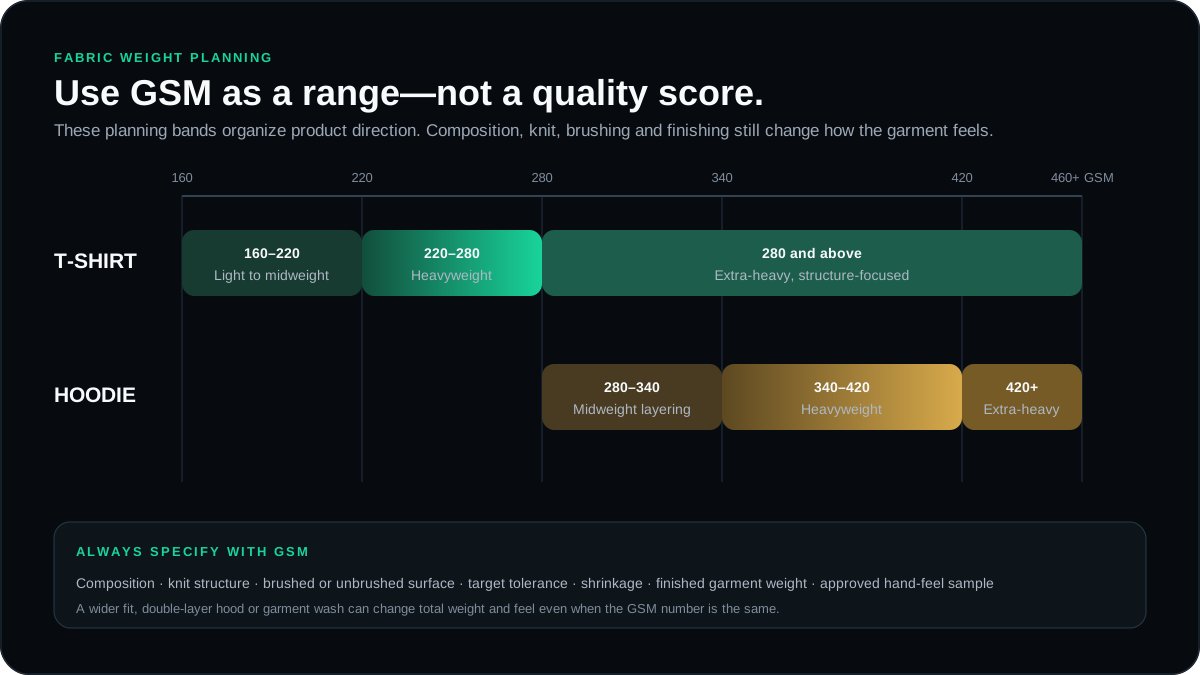
The ranges below are starting points, not universal industry grades. Confirm the actual fabric and finished garment for every program.
| Product | Planning range | Typical direction |
|---|---|---|
| T-shirt jersey | About 160-220 GSM | Light to midweight |
| T-shirt jersey | About 220-280 GSM | Heavyweight |
| T-shirt jersey | About 280 GSM and above | Extra-heavy, structure-focused |
| Hoodie fabric | About 280-340 GSM | Midweight layering |
| Hoodie fabric | About 340-420 GSM | Heavyweight |
| Hoodie fabric | About 420 GSM and above | Extra-heavy programs |
What does 350 GSM fleece mean?
A 350 GSM fleece has a measured fabric mass of about 350 grams per square metre. It is commonly considered a heavyweight hoodie direction, but the number alone does not define thickness or warmth. A dense 350 GSM loopback terry and a lofted 350 GSM brushed fleece can feel very different.
Before bulk production, approve composition, brushing, shrinkage, pilling or shedding, finished garment weight and the actual hand-feel sample. Compare the structures in the French terry vs fleece guide. For a garment example, see the 350 GSM brushed-fleece pullover and review its fit, fabric composition and sample approval points.
Why the same GSM can feel different
- Composition: cotton, polyester and blends have different density and moisture behavior.
- Knit: jersey, terry and fleece distribute mass differently.
- Brushing: a raised interior adds loft and warmth without changing the fibre label.
- Garment washing: shrinkage can increase measured mass per area and change hand feel.
- Pattern: a wide fit or double-layer hood changes total garment weight even at the same GSM.
What buyers should request with a GSM value
Copy this template into your supplier brief and fill in the agreed details before treating a sample as the bulk-production reference.
GSM specification to send with your brief
- Garment / intended use: [style, layering, target hand feel]
- Full fibre composition and knit: [composition; jersey, loopback or fleece]
- Finish: [brushed or unbrushed; other agreed finish]
- Target fabric weight: [___ GSM]
- Agreed tolerance and acceptance basis: [___; confirm with supplier]
- Measurement condition and method: [fabric state, conditioning, washing if applicable; method]
- Approved hand-feel sample: [sample ID, revision and approval date]
- Bulk sampling and approval: [which lot / samples; reviewer and approval owner]
- Other approval requirements: [shrinkage and colorfastness results, finished garment weight, opacity and decoration compatibility as relevant]
Agree on tolerances and approval requirements for the specific fabric and order. Matching GSM alone does not confirm fibre quality, appearance, shrinkage or the performance of the full production lot.
Review custom T-shirt manufacturing or custom hoodie manufacturing before submitting a project brief.