A T-shirt can meet its agreed length and width requirements while its side seams no longer sit where the buyer expects. If the body appears to turn after washing, a dimensional-change result alone does not settle whether that appearance is acceptable.
For a brand reviewing samples, the next step is to identify what changed, confirm which fabric or garment was evaluated, and compare the evidence with the project’s written requirements. The phrase “wash tested” needs enough detail to support that decision.
1. Recognize the change you are reviewing
Shrinkage concerns a reduction in measured dimensions. Seam twist concerns the direction or position of a seam around the garment. They can appear together, but an acceptable result for one does not establish an acceptable result for the other.
Spirality and torque appear in textile references for this family of rotational changes. Skew often describes the alignment of the fabric’s yarns or knitted loops. Use the terminology and measurement defined by the selected method when reading a report; these words do not make every reported percentage interchangeable. [1] [2] [3]
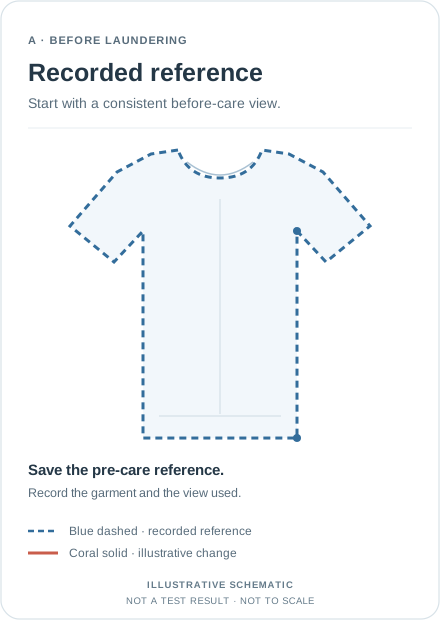
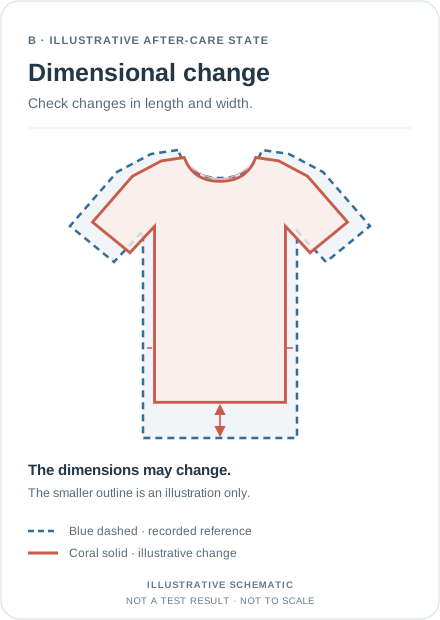
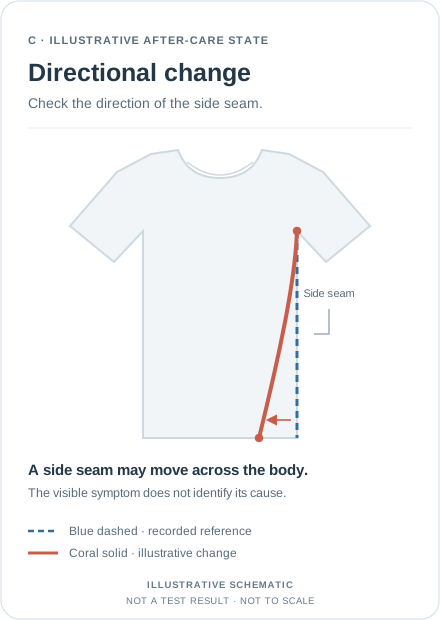
Open the full-size comparison →
Start with a description such as “the side seam moves toward the front near the hem after laundering.” Record local rippling or puckering separately if it is present. Photographs can show the visible condition, but they cannot establish its cause or replace a measurement procedure.
2. Consider possible causes without diagnosing from a photograph
Cotton Incorporated’s teaching material describes how yarn twist activity, knitted loop geometry and processing can affect fabric skew and garment torque. Materials and manufacturing history therefore belong in the investigation. A tilted seam does not, by itself, prove that the sewing operator or cutting team caused the problem. [1]
Ask the technical team to review the identified fabric and the garment’s construction and finishing route. Note whether the sample uses the intended production material or a substitute, and whether it has undergone the planned garment treatment.
For approval, request evidence about the actual material and garment. A description such as “heavyweight cotton,” an increase in GSM, or a promise to press the sample straight does not document its performance after the agreed care procedure.
3. Check what the test report actually measures
A fabric report and a finished-garment report answer different questions. ISO 16322-2 addresses spirality after laundering in woven and knitted fabrics; ISO 16322-3 addresses woven and knitted garments. Both official summaries caution that results from different procedures may not be comparable. [2] [3]
| Report detail | What the buyer needs to establish |
|---|---|
| Object and identity | Was the test performed on fabric or a complete garment, and does its reference match the material or sample under review? |
| Method and version | Which method and edition were used, and what condition or change does the method evaluate? |
| Care procedure | Which washing and drying procedures, number of cycles and other specified conditions apply? |
| Result and requirement | What was measured, in which units, and what project requirement is the result being compared against? |
AATCC’s 2026 manual announcement lists TM207-2025 for assessing garment seam twist before and after laundering, and TM179-2025 for changes in fabric skew after laundering. Ask the testing provider to confirm the suitable current method and procedure for the product; citing a method name alone does not define a pass result. [4]
Agree the acceptance requirement before deciding whether a result is satisfactory. Avoid borrowing a percentage limit from an unrelated garment, buyer or online article. Keep the dimensional measurements in the same review packet, using the garment shrinkage testing guide for that separate assessment.
4. Build a record that makes the missing evidence visible
Link the sample identity, photographs and report to the same specification version. The worked example below shows how to complete a review record when the available information is insufficient to close the seam-twist requirement.
| Field | Illustrative entry |
|---|---|
| Sample and specification | EXAMPLE-TEE-01; hypothetical cotton jersey T-shirt; size M; specification EXAMPLE-REV-B. |
| Material relationship | The fictional supplier identifies the sample fabric as EXAMPLE-JERSEY-A. Its relationship to the intended bulk fabric remains unconfirmed. |
| Before-and-after observation | The fictional review notes describe a side seam nearer the front at the hem after care. Before-and-after images exist in this scenario, but consistent measurement references were not recorded. |
| Test information received | The supplier note says “washed and dried.” It omits the method, edition, selected procedures and cycle count. |
| Dimensional-change evidence | A separate fictional report is marked “within the agreed dimensional limits.” Its sample identity and care procedure still need to be matched to this record. |
| Seam-twist result and criterion | No method-based seam-twist result or written acceptance criterion has been supplied. This item cannot be marked as passed. |
| Decision and next owner | The brand reviewer leaves seam-twist approval open. The supplier’s technical contact is asked to clarify the sample/material identity and arrange the missing evaluation with the testing provider. |
| Evidence needed to close | Confirmed sample and material references, applicable method and care procedure, agreed acceptance requirement, relevant result and a recorded reviewer decision. |
The record identifies the decision that is still open without assigning an unproven cause. It also prevents an unrelated dimensional result from becoming an approval of the entire garment.
5. Resolve three review gaps before bulk approval
Illustrative review scenarios — all three situations are fictional teaching examples, not reported Wincome orders, test results or customer outcomes.
SCENARIO 01
A washed sample arrives without a recorded starting condition
The buyer sees a side seam toward the front of the body. No reliable record shows the same sample before laundering.
What this establishes: the garment’s present appearance can be documented. The record cannot establish how much of that appearance was already present before washing.
Next step: preserve the current observation and ask the testing provider which method and reference conditions are needed to answer the project’s question. If a before-and-after comparison is required, obtain a suitable identified sample and record its starting condition before the agreed evaluation.
Review decision: keep the amount of wash-induced change unresolved. Do not report it as zero, or infer a failed numerical limit that has not been assessed.
SCENARIO 02
Two reports use different objects or care procedures
One fictional report concerns fabric; another concerns a finished T-shirt. Their drying procedures also differ. The buyer is tempted to choose the smaller reported percentage.
What this establishes: each report describes its own evaluation. A smaller number alone does not establish better performance under equivalent conditions.
Next step: ask the testing provider to explain the methods, objects, units and conditions. Where a direct comparison is needed, agree a suitable evaluation for the identified samples under comparable procedures.
Review decision: retain both reports with their limits of application. Do not average the numbers or substitute the fabric result for garment acceptance.
SCENARIO 03
Dimensions meet the agreed limits while seam twist remains unresolved
In this fictional scenario, the dimensional-change evidence is valid for the identified sample and agreed care procedure. The side-seam observation has no corresponding assessment against a written requirement.
What this establishes: the dimensional requirement can be recorded as satisfied within that report’s scope. It does not settle the separate seam-twist or appearance requirement.
Next step: define the unresolved requirement with the relevant technical or testing party and obtain the appropriate evidence. If the garment is revised, identify the new version and decide which checks need repeating.
Review decision: record the dimensional result separately and leave seam-twist approval open. Do not convert a partial review into unrestricted bulk approval.
6. Record the action and the exact approval scope
A useful review comment connects an observation to the evidence needed for a decision. It identifies the sample, unresolved requirement, responsible role and next review point.
Illustrative review comment: “For sample EXAMPLE-TEE-01, please confirm the fabric relationship to bulk and the method and care procedure used. The available information does not close seam-twist approval. Please return the agreed evaluation and supporting record before that requirement is signed off.”
If material, construction or finishing changes, record the revision and ask which earlier findings still apply. Preserve the accepted sample reference and the supporting decision together. The pre-production sample checklist covers the wider approval record, while the garment inspection checklist connects agreed requirements to checks on the order.
For a custom T-shirt project, include the fabric reference, intended care instructions, decoration, quantity and any seam-twist requirement in the enquiry. Ask which sample evaluation and supporting evidence can be arranged for that project before treating the requirement as confirmed.
Sources and scope
This guide explains buyer review decisions. Testing procedures, specimen numbers and acceptance requirements must be established for the applicable product and method. The drawings, worked record and scenarios are illustrative; they do not report a Wincome test or establish a universal pass limit.
- Cotton Incorporated / Cotton University — Garment Skew or Torque. Background on terminology and contributing factors. Its historical method descriptions are not a substitute for current procedures.
- ISO 16322-2:2021 — Determination of spirality after laundering, woven and knitted fabrics. Public scope summary.
- ISO 16322-3:2021 — Determination of spirality after laundering, woven and knitted garments. Public scope summary, including limits on comparing procedures.
- AATCC — 2026 methods manual update. Confirms the titles and 2025 revisions of TM179 and TM207.