How to find a reliable clothing manufacturer: the quick answer
Start with a clear product brief, find candidates through more than one channel, verify who they are and what role they perform, send each candidate the same RFQ, pay for comparable samples, examine how the approved sample will control bulk, and begin with an order whose financial and inventory risk you can manage.
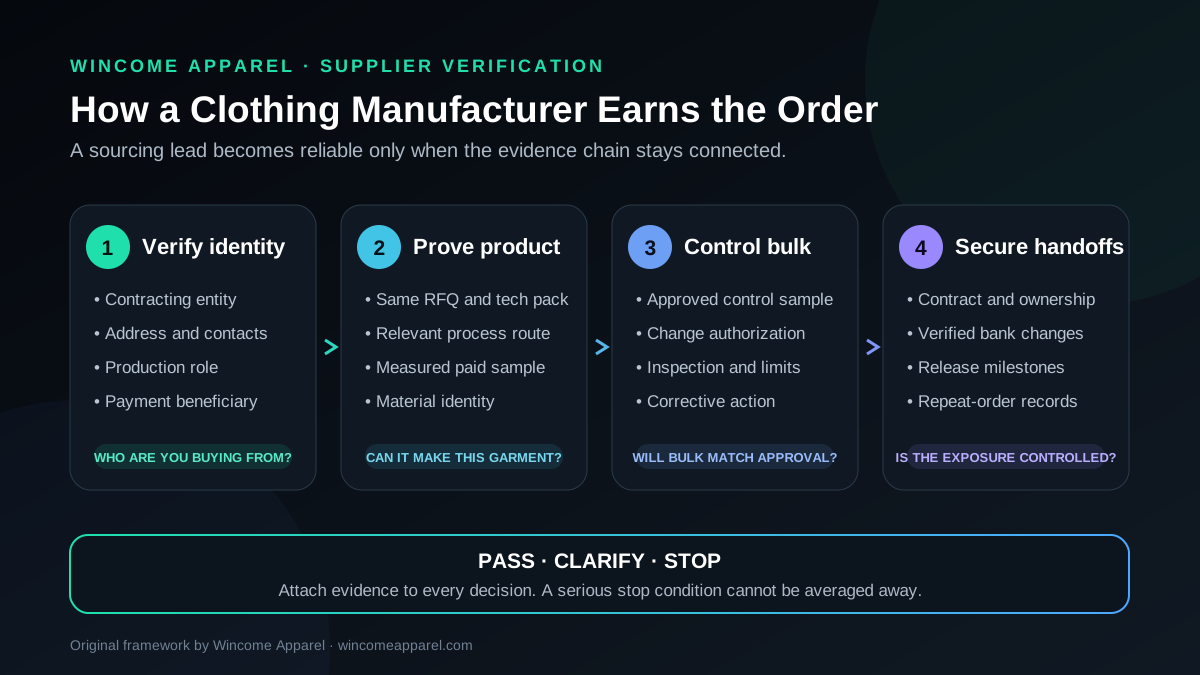
A directory badge, recommendation, factory video, certificate, low quote or good sample can support one part of the decision. None proves the complete production system. A reliable clothing manufacturer is one that can repeatedly connect the legal and commercial party, the approved product specification, the production route and the bulk quality evidence.
Where to find clothing manufacturer candidates
Brands commonly build a shortlist through referrals, trade shows, industry directories, search engines, sourcing platforms, local associations, agents or production-management partners. Use several channels so one platform’s ranking or sales claims do not define the whole market.
| Source channel | Useful for | What it does not prove |
|---|---|---|
| Founder or industry referral | Relationship context and a starting introduction | Fit for your product, quantity, market or current capacity |
| Trade show or association | Meeting several suppliers and reviewing process samples | The exhibitor controls every advertised operation |
| Directory or sourcing platform | Searchable candidate discovery and initial communication | Bulk quality, identity continuity or contract performance |
| Search engine or social media | Finding specialist processes and recent work | Ownership of images, business status or production control |
| Agent or production partner | Coordinating factories, materials, approvals and inspections | That responsibilities, fees and subcontracting are already clear |
Shortlist by the actual garment and order. A widely recommended basic-jersey supplier may still be unsuitable for a heavyweight washed hoodie, a tailored woven style or a complex mixed-decoration program.
Factory, trading company or production partner?
A direct factory, trading company and production-management partner are different operating models, not automatic quality grades. Apparel orders often combine knitting or weaving, dyeing, cutting, sewing, washing, printing, embroidery, labeling and packing. One legal entity may not perform every process itself.
| Question | Why it matters |
|---|---|
| Who is the contracting entity? | Connects the quotation, agreement, invoice and accountability |
| Who receives payment? | Allows the buyer to verify the beneficiary against the agreed commercial party |
| Where does each process occur? | Shows which operations are in-house, coordinated or subcontracted |
| Who owns the approval record? | Identifies who controls the tech pack, samples, artwork and changes |
| Who handles nonconformity? | Defines corrective action when a process or supplier fails |
| Can the route change without approval? | Prevents undisclosed factory, material or process substitutions |
A capable partner can add value by coordinating specialists; a direct factory can still subcontract an operation. Ask for a transparent process map and named responsibility instead of relying on the word “factory.”
1. Verify product and order fit
Prepare a consistent apparel tech pack or structured brief covering garment type, fit, measurements, fabric structure and weight, construction, decoration, wash, trims, labels, packing, quantity and destination. Then ask the candidate to explain the proposed route and unresolved points.
- Relevant garment and construction experience
- Material sourcing route and substitute rules
- Pattern, grading and size-range capability
- Wash, print, embroidery or other specialist processes
- MOQ by style, material, color and decoration
- Testing and destination-market requirements
- Capacity for the requested order window
- Repeat-order records and retained references
First decide whether the project is white label, private label or custom cut-and-sew, then use the domestic vs overseas manufacturing framework as a separate location and operating-system decision.
2. Cross-check business and payment identity
Ask for the full contracting name, registration details, operating address, responsible contacts, quotation, invoice information and intended payment beneficiary. Cross-check them through the applicable official registry, independent business sources or qualified due-diligence providers for that country. A business registration can show that an entity exists; it does not prove apparel capability or future performance.
Resolve these mismatches before payment
- The quotation, contract and invoice name do not align.
- The beneficiary is unrelated and the commercial reason is undocumented.
- The address, contact domain or responsible person changes without explanation.
- The supplier asks for a last-minute change to bank details or payment procedure.
- The buyer cannot independently reach the known contact to verify the change.
The FBI’s business email compromise guidance advises businesses to verify changes in account numbers or payment procedures through a known contact. Do not verify a suspicious change only with the new email address or phone number supplied in that request.
3. Use the RFQ as a communication test
Send the same inputs to every shortlisted manufacturer. The objective is not only to receive a price; it is to see whether the candidate identifies missing decisions, separates assumptions and explains how the garment will be controlled.
Before sending the full request, use this clothing manufacturer first-contact guide to structure a message that earns a useful reply. Then use the custom clothing RFQ template and compare the responses with the custom clothing quotation guide.
| Strong response behavior | Risk signal |
|---|---|
| Questions unclear specifications | Confirms every request without technical review |
| States material and construction assumptions | Quotes from reference images without defining the product |
| Breaks out MOQ and setup constraints | Uses one low headline minimum for every variation |
| Names sample and approval stages | Pushes directly to bulk before controlled sampling |
| Defines inclusions, exclusions and quote validity | Leaves delivery, labels, testing or inspection unpriced |
| Keeps decisions in a dated record | Changes key terms across scattered messages |
Fast replies can help, but clarity, consistency and ownership are stronger signals than response speed alone.
4. Make the sample prove bulk readiness
A good-looking sales sample is not enough. Follow a defined clothing sample process and identify what each stage approves. Record the sample version, actual materials, measurements, artwork, construction, substitutions and comments.
Connect the approved sample to bulk
- Identify the control sample. Record the signed or otherwise approved version that bulk must follow.
- Lock production inputs. Identify approved fabric, color, trims, labels, artwork and permitted tolerances.
- Control changes. Require written approval before substituting a material, process or production location.
- Inspect during the order. Use pre-production, inline or final checks appropriate to the risk instead of waiting only for delivered stock.
- Retain repeat-order evidence. Keep specifications, measurement records, artwork, material references and corrective actions.
Use the pre-production sample checklist and garment inspection checklist to define measurable acceptance rather than relying on “same as sample.”
Reliable clothing manufacturer scorecard
This 100-point model is a starting framework, not a universal certification. Adjust the weights for the product and market, attach evidence to every score and apply stop conditions separately.
| Evaluation area | Suggested points | Evidence to attach |
|---|---|---|
| Product and process fit | 20 | Relevant sample, process route, materials and equipment/capability evidence |
| RFQ and specification discipline | 15 | Assumption list, itemized quotation, MOQ layers and revision control |
| Sample evidence | 15 | Measured sample, material identity, comments and approval record |
| Bulk quality and change control | 20 | Inspection plan, limits, reports, substitution and corrective-action process |
| Commercial identity and payment controls | 15 | Cross-checked entity, contract, invoice, beneficiary and known contacts |
| Communication, capacity and continuity | 15 | Named owners, milestones, escalation route, capacity and repeat-order records |
How to use the score
- Pass: evidence supports the requirement and can enter the order control pack.
- Clarify: the route may work, but a sample, document, independent check or revised quote is still required.
- Stop: identity, payment, safety, compliance, intellectual property or material product risk cannot be resolved.
Do not average away a serious stop condition with a high total score. A single unresolved beneficiary or product-safety issue can outweigh several positive sales signals.
Clothing manufacturer red flags
- Pressure to pay before the product, entity and commercial scope are clear
- An unusually low quote that omits materials, sample work, labels, inspection or delivery
- Copied-looking images or credentials that cannot be connected to the supplier
- Vague answers about fabric source, construction, subcontracting or production location
- Refusal to make or identify an order-specific paid sample
- Different names across the quotation, contract, invoice and beneficiary without documented reason
- Unexpected urgency or last-minute bank-account changes
- A sample route that cannot be connected to bulk materials and inspection
- Unapproved substitutions or production moves
- No named owner for defects, rework or corrective action
One red flag may be a correctable documentation gap, not proof of fraud. Pause, verify independently and record the resolution. The FTC small-business scam guide recommends checking who you are dealing with and researching complaints before doing business with a new company.
5. Confirm commercial controls before the deposit
Align the technical and commercial records before money is committed. Payment method, deposit structure, inspection milestone, title, risk transfer, remedies and contract enforceability depend on the transaction and jurisdictions; obtain qualified advice when the exposure requires it. No payment channel replaces supplier verification, and no contract guarantees performance by itself.
- Contracting entity and authorized signer
- Verified payment beneficiary and change-verification procedure
- Final product specification and approved sample status
- Quantity, price, currency and included scope
- Milestones, approval owners and change process
- Inspection, release and nonconformity procedure
- Pattern, artwork and intellectual-property terms
- Packaging, shipping and import responsibilities
The U.S. International Trade Administration recommends careful due diligence on foreign representatives and requesting detailed business information and references. Its foreign representative evaluation guidance is not an apparel-specific factory certification, but its identity, reference and site-verification principles are useful when screening overseas commercial partners.
6. Start with controlled exposure and monitor reorders
A first order should be large enough to test the intended production route but small enough that the brand can manage the inventory and financial exposure. “Small” depends on garment complexity, material minimums, budget and demand; it is not one universal quantity.
After delivery, compare the production result with the approved specification, inspection findings, delivery record and customer feedback. Reliability is not permanent after one good order. Recheck material continuity, capacity, account details, corrective actions and approved changes on repeat production.
A documented long-term streetwear production relationship shows why completed orders, restocks, paid samples and new-product records provide stronger evidence over time than a single transaction.
Sources and research note
This guide was expanded around recurring apparel-founder questions about manufacturer legitimacy, samples that do not translate to bulk, vague communication, trading-company roles, low quotes and payment risk. Community discussion identifies buyer language and failure points; it does not prove that a country, platform or supplier type is reliable or unreliable. Commercial-risk statements were checked against primary U.S. government guidance:
- U.S. International Trade Administration: Evaluate Foreign Representatives
- Federal Bureau of Investigation: Business Email Compromise
- Federal Trade Commission: Scams and Your Small Business
This page is general sourcing guidance, not a supplier guarantee or a replacement for legal, financial, compliance, testing or country-specific due diligence.