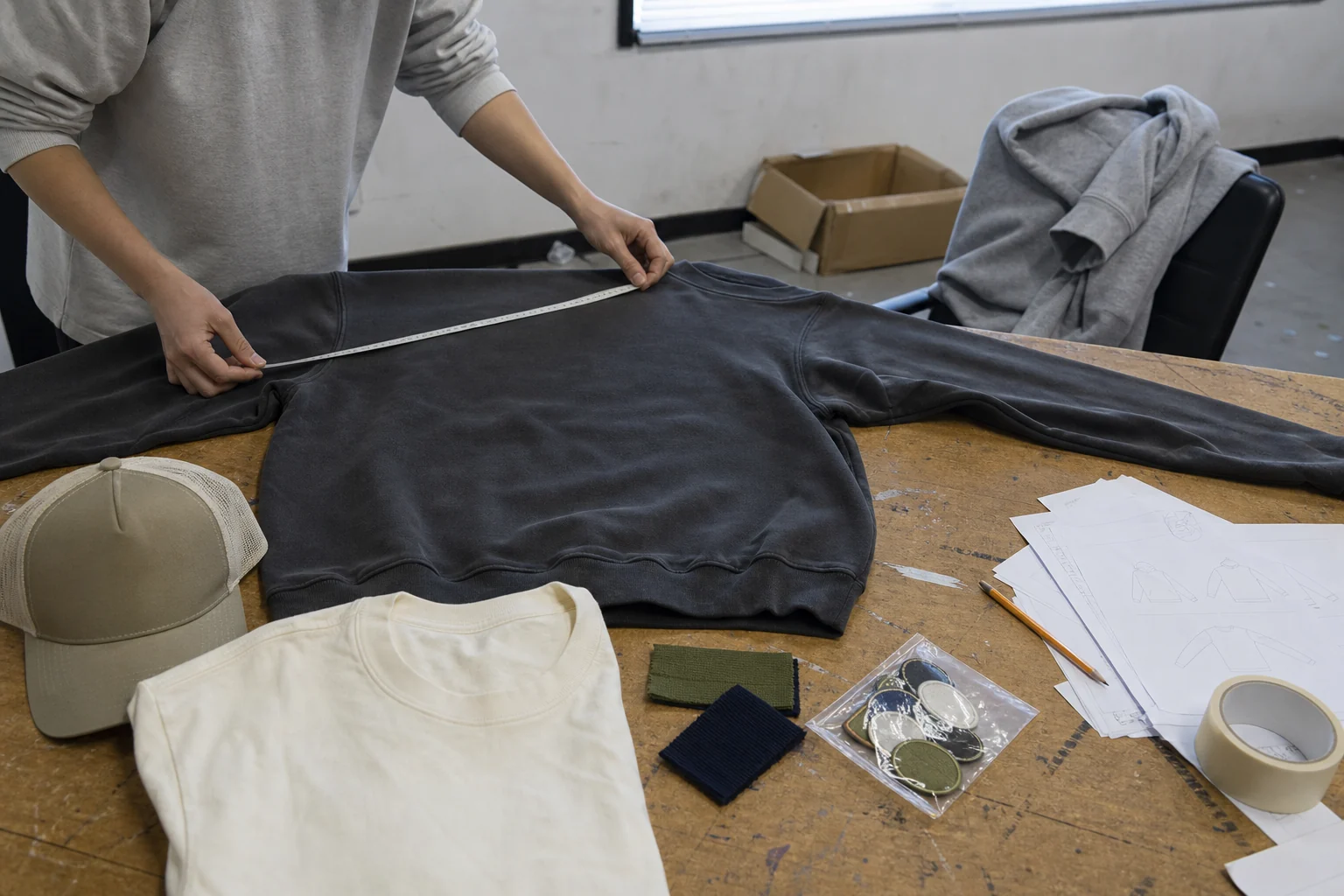
What was verified in this repeat custom apparel case
The buyer's account panel showed 12 order records. Nine individually visible records were explicitly marked completed, while a separate 2026 development record was still awaiting buyer confirmation. Those statuses are kept separate: this page does not turn an active sample or a discussion into a completed wholesale order.
The completed records cover heavyweight crewneck sweatshirts, repeat custom T-shirt programs, a custom trucker-hat order and later multi-product purchasing. Dated messages from April through July 2026 document the next development cycle: textured ribbed fabric, a cropped hoodie, wide-leg drawstring shorts, a more feminine T-shirt fit and custom embroidered patches.
The evidence supports a long-term custom apparel sourcing relationship. It does not prove that every discussed design, quantity or sample became a bulk order, and it does not establish a standard price, MOQ or lead time.
How the wholesale apparel program expanded over time
This relationship is useful trust evidence because it shows category expansion across multiple years, not one isolated order described as a partnership. The visible account records and recent messages support the following progression.
- September 2022 — heavyweight crewneck programThe earliest visible completed record included a 276-unit line for 350 GSM crewneck sweatshirts within an eight-product order.
- June to July 2024 — repeat crewneck productionTwo more completed records included visible crewneck lines of 300 and 120 units, showing continued purchasing after the first program.
- September 2024 — custom trucker hatsA completed 300-unit trucker-hat record expanded the relationship beyond cut-and-sew tops.
- October 2024 to April 2025 — repeat custom T-shirtsThree completed multi-product records included visible T-shirt lines of 120, 120 and 240 units.
- August 2025 to March 2026 — larger multi-product ordersA completed two-product record included a visible 384-unit line. A later completed three-product order included a visible 1,220-unit line. These are line quantities, not claims about the total units in each order.
- April to July 2026 — new product developmentThe buyer returned with ribbed-set, cropped-hoodie, wide-leg-short, feminine-fit T-shirt and embroidered-patch requests. Sample comments and revision decisions were still active when reviewed.
Turning apparel sample feedback into measurable revisions
Recent messages show the buyer evaluating more than appearance alone. The buyer asked to review textured ribbed fabric, color options and a looser silhouette before the sample direction was finalized. The exact customer fabric and color selections are withheld; the public case focuses on the approval process rather than reproducing a private product specification.
After receiving a sample, the buyer said the lower garment read more like a skirt than shorts, requested a wider leg with a drawstring and asked for a larger logo treatment. Those comments can be translated into controlled revisions: opening width, outseam, rise, leg shape, waistband construction and decoration dimensions. A revision is more useful when each comment is connected to a measurement or approved visual reference.
Buyers preparing a comparable program can use our pre-production sample checklist to connect fit comments, fabric approval, decoration and packaging to one controlled version.
Managing multi-category apparel sourcing under one relationship
Crewneck sweatshirts, jersey T-shirts, trucker hats, ribbed sets and embroidered patches do not share one identical production route. Each category has different material, construction, decoration and inspection risks. The value of a long-term apparel production partner is not pretending those differences disappear; it is keeping the brief, approved sample, responsible facility and quality evidence clear for each program.
- Keep a separate specification, sample version and size breakdown for every garment category
- Confirm finished GSM and composition against the actual program rather than carrying an old fabric assumption forward
- Match decoration methods to the fabric, artwork scale and expected wash performance
- Use controlled artwork dimensions and placement references for each style
- Record which labels, packaging and carton marks apply to each product group
- Define category-specific inspection points for sewing, measurements, decoration and appearance
- Separate completed orders from active samples, quotations and requested quantities
- Reconfirm freight route and arrival priorities when several categories ship together
For product-specific planning, review our custom T-shirt production guide and custom hoodie sourcing route.
What the recent shipping and product-development messages reveal
During the 2026 development stage, the buyer asked for an arrival update after a shipment took longer than expected. The response separated a slower sea route from a smaller parcel and acknowledged the buyer's urgency. The reviewed messages do not provide enough evidence to claim a specific delivery result for that active development order, so this case limits the conclusion to documented follow-up and route clarification.
After that exchange, the buyer continued discussing samples, T-shirt fit and embroidered patches. Continued development is a meaningful trust signal, but it is not presented as proof that those later products were completed. This distinction helps wholesale buyers evaluate both relationship strength and current project status without inflated claims.
Why repeat apparel orders are stronger than a generic testimonial
A positive sentence can be useful, but repeated buyer behavior provides deeper evidence. Here, the trust signal comes from completed records across several calendar years, expansion from sweatshirts into T-shirts and headwear, larger later order lines, and a new development cycle that included direct sample criticism rather than only praise.
The relationship also shows that long-term sourcing does not mean every discussion becomes a transaction. One visible 2026 development record remained awaiting buyer confirmation, and several newly requested styles were still being refined. Publishing those boundaries makes the case more credible for buyers comparing custom clothing partners.
What this long-term buyer case proves — and what it does not
- The account history showed 12 order records across a relationship beginning in September 2022
- Nine individually visible records were explicitly marked completed
- Visible completed categories included crewneck sweatshirts, custom T-shirts and trucker hats
- Later records included larger multi-product order lines
- Recent messages documented new sample development and specific fit and decoration feedback
- One visible development record was not counted as completed
- Visible line quantities are not presented as total order quantities when a record included multiple products
- Discussed ribbed sets, cropped hoodies, wide-leg shorts and patches are not claimed as completed bulk orders
- The case does not establish a standard MOQ, unit price, lead time, fabric or shipping result