What should a clothing label and packaging brief include?
A production-ready brief lists every label, tag, sticker, bag and carton component, then defines its artwork, exact wording, material, finished size, color, placement, attachment, quantity and approval status. It also separates fixed brand content from size-, color-, SKU-, order- and destination-specific data.
Do not send a logo and ask the manufacturer to fill in the rest. Identify the target market and sales channel, assign the final compliance and barcode decisions, provide a packing matrix, and state which digital proof, physical sample and packed-garment evidence must be approved before bulk.
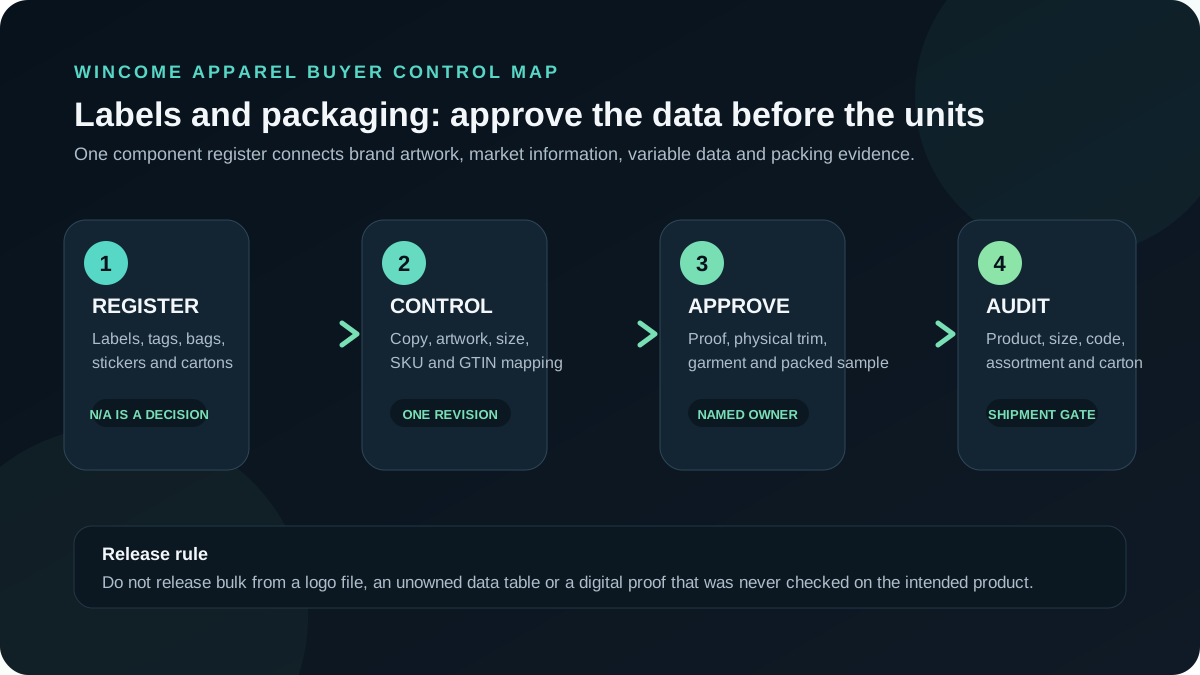
Separate three layers before choosing components
Labels and packaging solve different problems. Separating the layers prevents an attractive brand element from being mistaken for required product information or a warehouse instruction.
| Layer | Typical components | Decision owner | Main risk if unclear |
|---|---|---|---|
| Product information | Fiber composition, care, origin, responsible business identity, size and market-specific statements | Buyer or assigned compliance adviser; supplier confirms production feasibility | Missing, inaccurate or market-inappropriate consumer information |
| Brand presentation | Main label, neck print, patch, hangtag, insert, tissue and branded retail presentation | Brand team with production review | Artwork, material, color, comfort or finish does not match the approved product |
| Fulfillment and logistics | SKU sticker, barcode, individual bag, packing ratio, carton label and shipping mark | Buyer, retailer, warehouse or logistics owner; packing team applies the instruction | Incorrect assortment, receiving delay, failed scan or repacking |
The same physical label can carry information from more than one layer, but the responsibility for each field should remain visible in the brief.
Build one component register
Name each required component and mark anything that is not applicable. An empty row means “not decided”; a recorded N/A means the decision has been made.
| Component | Buyer should define | Approval focus |
|---|---|---|
| Main or neck label | Type, artwork, finished dimensions, fold, material, color, position and stitch or application method | Logo detail, color, edge comfort, orientation, attachment and appearance on the intended garment |
| Size identification | Size system, displayed value, location and whether it is separate or combined | Correct size-to-garment match, legibility and consistency across the range |
| Care, content and origin label | Approved wording, languages, symbols, identity data, dimensions, material and placement | Copy accuracy, legibility, attachment, durability and correct style/color mapping |
| Hangtag or insert | Front/back artwork, copy, size, stock, finish, hole/string, attachment and variable fields | Trim, print, orientation, attachment location and correct SKU or price data |
| Barcode or SKU label | Source number, symbol requirement, human-readable text, product mapping, size and placement | Correct data, contrast, quiet zones, print quality and a scan in the intended environment |
| Individual garment pack | Fold method, bag or wrap type, dimensions, closure, sticker, warning and item count | Garment protection, presentation, correct label and consistent fold |
| Retail or ecommerce presentation | Box, mailer, tissue, seal, insert and assembly order when included in factory scope | Fit, protection, opening sequence, print and shipment-volume implications |
| Master carton | Assortment, units per carton, carton requirements, marks, labels and receiving rules | Quantity, size/color ratio, carton identity, weight/dimension limits and readable marks |
For the wider document package, use the manufacturer file-handoff guide. This page owns the component-level specification; the handoff guide owns the complete quote, sample and bulk folder.
Choose label construction by the product and evidence
There is no universally best label type. Compare what the artwork needs with skin contact, the fabric surface, garment finishing, application sequence and expected laundering.
| Direction | Useful decision questions | Evidence to request |
|---|---|---|
| Woven label | Can the weave reproduce the smallest text and shapes? Which fold and edge will contact the wearer? How will it be attached? | Artwork proof, physical strike-off or sample, sewn placement and wash review where applicable |
| Printed fabric label | Which substrate and print process suit the copy density, hand feel and care conditions? Is text still legible at finished size? | Actual-size proof, physical sample, rub or wash evidence appropriate to the project |
| Heat-transfer or tagless mark | Is the garment fabric and finish compatible? Will stretch, heat, wash or garment treatment affect adhesion and legibility? | Application on the intended fabric, correct production sequence and washed sample where relevant |
| Separate size tab | Does one common main label with variable size tabs simplify the range? Where is the tab attached and oriented? | Size mapping, sewn sample and assortment check |
| Patch or special trim | What is the material, edge, backing, attachment and interaction with wash or dye processes? | Physical component and finished-garment sample after applicable processing |
A screen preview can confirm layout direction, but it cannot prove thread definition, substrate feel, edge comfort, adhesion or performance after finishing.
Assign market and care-label responsibility
Required information changes by product and destination. The buyer should state where the goods will be sold, which rules or retailer requirements apply, who supplies the final wording and who gives the compliance release. A manufacturer can review feasibility and reproduce approved data, but should not be expected to infer legal content from a logo, fabric nickname or previous order.
- For the United States, the FTC explains that most covered textile and wool products disclose fiber content, country of origin and the identity of the manufacturer or another responsible business. A separate FTC rule requires care instructions for covered apparel. Review the official Textile and Wool labeling guide and Care Labeling Rule guidance.
- For the European Union, the official textile label overview describes fiber-composition labeling, non-textile parts of animal origin and language requirements for markets where the product is offered.
Map fixed and variable data before artwork is multiplied
One attractive master design can still produce dozens of label or sticker variants. Create a controlled data table before generating production artwork.
| Data type | Examples | Control |
|---|---|---|
| Fixed brand data | Logo, brand colors, standard website or approved brand statement | One master artwork version and named owner |
| Style-specific data | Style code, product name, composition, care route or country of origin | Map each value to the applicable style and color; do not reuse by assumption |
| Size-specific data | Displayed size, region-specific size or size tab | Match the approved size system to the garment and quantity matrix |
| SKU or channel data | SKU, GTIN, barcode symbol, retail price, retailer/vendor or purchase-order fields | Buyer- or retailer-approved source table with field owner and revision date |
| Packing data | Units per bag or carton, size/color ratio, carton number and destination mark | Final packing matrix reconciled to the purchase order and shipment plan |
GS1 states that the organization that owns the trade-item specification is normally responsible for GTIN allocation. If GS1 identifiers are required, the brand or designated allocator should control the number and product mapping; the manufacturer can print or apply the approved code. See GS1’s official barcode and GTIN guidance.
Define each packaging level separately
“Custom packaging” is not one instruction. A garment bag, ecommerce mailer, retail box and export carton serve different functions and may be supplied or applied by different parties.
- Garment presentation. Record folding, tissue or insert use, hangtag position, individual bag or wrap, closure and size/SKU sticker.
- Consumer-facing pack. If a retail box, belly band, branded mailer or other presentation is in scope, define dimensions, artwork, assembly and which product variants it serves.
- Inner grouping. State whether pieces are grouped by style, color, size, set or store allocation and how the group is identified.
- Master carton. Define carton quantity and assortment, carton label or mark, numbering, destination, handling requirements and any limits supplied by the freight, warehouse or retailer owner.
Custom boxes and presentation layers should be reviewed against product protection and shipping volume as well as appearance. A box that looks correct in a render can create wasted space, crushing risk or unexpected freight implications when dimensions and loading are not tested.
Use one label and packaging specification sheet
The sheet can be part of the tech pack or a controlled appendix. Give every component a unique name and status so quotation, sample and bulk teams refer to the same item.
| Field | What to record |
|---|---|
| Order context | Style codes, product type, color/size quantity matrix, target markets, sales channels and destination |
| Component ID | Unique name or code for every label, tag, sticker, bag, insert and carton item |
| Artwork and copy | Editable source where appropriate, review PDF, exact text, fonts or outlined type, color references and front/back orientation |
| Physical specification | Finished dimensions, material or construction direction, thickness or weight where relevant, fold, edge, finish, hole, string or closure |
| Application | Measured garment position, orientation, attachment or application method and operation sequence |
| Variable mapping | Style, color, size, SKU, GTIN, price, order and carton fields linked to the quantity matrix |
| Commercial scope | Quantity, separate component minimum, setup or tooling, unit, surplus ownership and reuse plan |
| Approval plan | Digital proof, material sample, sewn garment, packed sample, barcode scan and named approver |
| Revision control | File name, revision, date, change note, approval status and the superseded version |
Use the apparel tech pack guide for the full garment specification and BOM. Keep labels and packaging linked to, but not hidden inside, the product revision record.
Approve in the order that reduces irreversible risk
- Register the components. List every item and identify fixed versus variable fields.
- Complete responsibility review. Confirm the target markets, retailer/warehouse inputs, final copy owner, barcode owner and open decisions.
- Run production preflight. Check artwork format, actual size, legibility, material, fold, placement, application and quantity before proofs are made.
- Approve digital proofs. Review copy, layout, orientation, colors, die lines and variable-data logic. A digital proof is not physical approval.
- Approve physical evidence. Review label or packaging samples and the applied component on the intended garment where needed.
- Approve one packed sample. Confirm folding, tag and sticker position, product-to-SKU match, bag or box fit and presentation sequence.
- Freeze the release set. Mark the approved revision, date and approver; remove superseded files from the bulk folder.
- Audit bulk packing. Reconcile garment, label, SKU, size/color assortment and carton information before shipment release.
Connect the finished-garment check to the pre-production sample approval checklist; a label proof alone does not establish correct attachment or correct product-to-data matching.
Know what each approval can and cannot prove
| Evidence | Helps confirm | Does not prove alone |
|---|---|---|
| Artwork or data review | Copy, identifiers, file version and mapping logic | Physical size, color, feel, attachment or print quality |
| Digital proof | Layout, orientation, approximate color direction and variable fields | Actual substrate, weave/print detail, edge comfort, adhesion or scan quality |
| Loose physical sample | Material, dimensions, print or weave result and finish | Placement, attachment, garment interaction or correct assortment |
| Applied garment sample | Position, orientation, stitch/application and wearer contact | Complete folding, individual packaging or carton allocation |
| Packed garment sample | Fold, hangtag, sticker, bag/box fit and presentation sequence | Full order quantity or carton-by-carton accuracy |
| Barcode scan record | Whether the printed symbol reads under the tested conditions | Whether the number was assigned to the correct product or accepted by every retailer |
| Bulk packing audit | Sampled label, SKU, assortment, quantity and carton conformity | Requirements that were never defined in the approved specification |
Separate garment MOQ from component constraints
Labels, hangtags, bags, stickers and boxes can each have their own supplier minimum, setup, tooling, print run, material availability and lead-time dependency. Ask for these separately from garment MOQ.
- Minimum and quoted quantity for each component
- Setup, plate, die, mold or sampling charges where applicable
- Unit of measure and whether variants can share a run
- Sample and approval timing before bulk production
- Required date at the sewing or packing location
- Who owns unused labels or packaging and where they are stored
- Whether surplus can be reused for a repeat order without obsolete data
- Cost and timing consequence if copy, barcode or artwork changes after approval
Do not assume that combining all items under one phrase such as “private-label packaging included” makes the commercial scope complete. The quotation should name what is included, excluded, buyer-supplied or still open.
Label and packaging warning signs
- A logo is treated as the complete label specification
- The production team is expected to guess fiber, origin, identity, language or care wording
- A barcode image has no controlled source number or product mapping
- Artwork is viewed only on screen and never checked at actual finished size
- Garment quantities and label or sticker variants are not reconciled
- A digital proof is treated as evidence of physical color, feel, attachment or wash performance
- Old care-label, price or retailer data is reused without confirmation
- Changes remain in chat messages instead of the current revision
- Custom packaging is selected before product fit, protection and shipping dimensions are checked
- Environmental or recycled-content claims have no applicable material or supplier evidence
- The packed sample does not represent the intended bulk assortment
- Carton marks are prepared before the destination and receiving instructions are final
Final checklist before releasing labels and packing
- Target markets, sales channels and destination confirmed
- Final compliance and retailer-review responsibility assigned
- Every component listed or marked not applicable
- Exact copy and editable/review artwork supplied
- Finished size, material, color, fold and finish recorded
- Placement and attachment measured from named garment points
- Fixed and variable fields separated
- Size, SKU, GTIN and carton data mapped to the quantity matrix
- Each component minimum, setup and surplus rule confirmed
- Digital proofs approved with revision and date
- Applicable physical and applied-garment samples approved
- One packed sample reviewed before bulk packing
- Barcode source, mapping and scan evidence checked where required
- Superseded files removed from the release folder
- Bulk packing audit and shipment-release owner named
Add the completed sheet to the custom clothing RFQ during quotation, then carry the approved revision into sample and bulk production instead of recreating the instructions at each stage.
Research note
This guide was developed from a current search-intent review of buyer questions about custom clothing labels, hangtags, barcodes and packaging. Market-specific statements were checked against official FTC, European Union and GS1 guidance linked above. Competitor pages were used only to identify recurring questions and content gaps; no supplier price, MOQ, lead time or capability claim was adopted.
Intent boundary: this page owns label and packaging component specification, variable-data control and approval evidence. The RFQ, tech pack, manufacturer file-handoff, branding-method and pre-production sample pages retain their broader commercial, garment-development and approval roles.