What should you say to a clothing manufacturer?
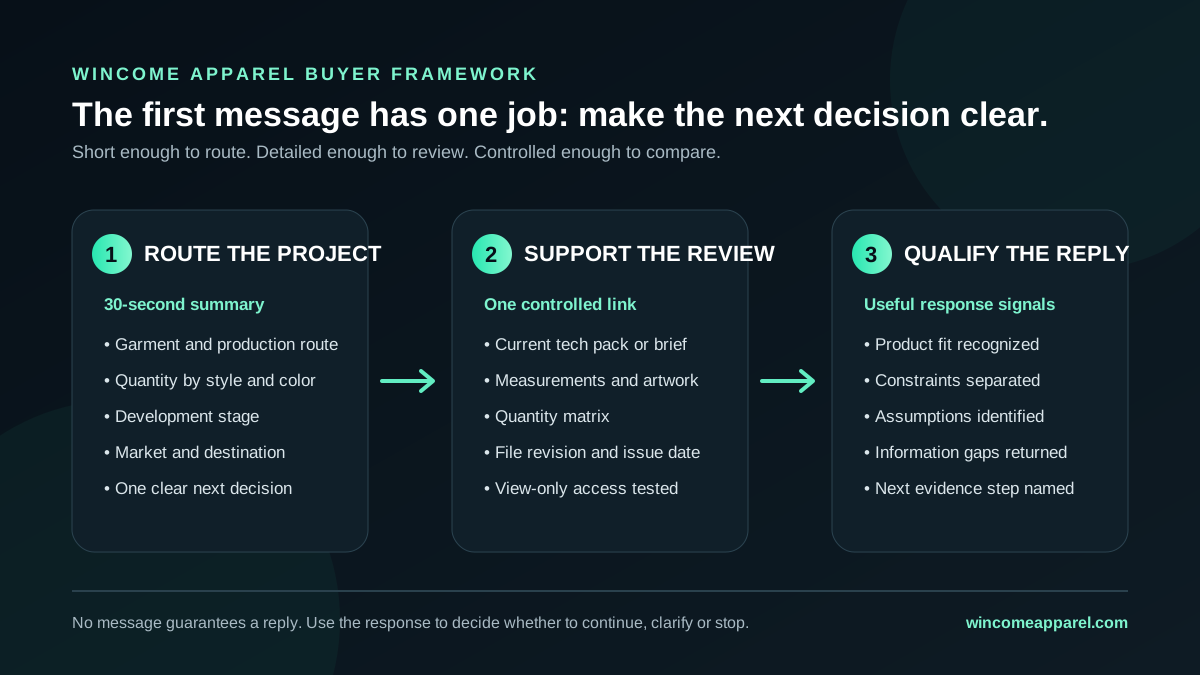
Start with a short project summary that names the garment, production route, quantity by style and color, current stage, target market or destination, key material or decoration needs, and the decision you need from the manufacturer. Then share one controlled link to the current tech pack, references or RFQ. Ask whether the project fits the supplier and what information is missing before requesting a final quote.
Why a detailed inquiry can still receive no useful reply
A complete tech pack can describe a garment well and still leave the first-contact decision unclear. Before a recipient opens ten pages of measurements and artwork, someone usually needs to decide whether the request belongs with that supplier, product team or order route.
| First-contact problem | What the recipient cannot decide | Buyer correction |
|---|---|---|
| Only a reference image is sent | Whether the request is a blank, private-label base or custom cut-and-sew garment | Name the production route and current stage |
| The message says only “What is your price?” | What product, quantity and commercial scope should be quoted | Add the garment, order structure, destination and file link |
| A long tech pack arrives with no summary | Whether the project fits the supplier before a full review | Put the routing facts in the message body |
| One total quantity is provided | How styles, colors and processes divide the order | State quantity by style and color; attach the size matrix if available |
| The shared folder cannot be opened | What the current specification actually contains | Test the view-only link outside your signed-in account |
| Every candidate receives the same generic mass message | Why this supplier appears relevant to the actual garment | State the capability or route you are asking that candidate to review |
No reply has many possible causes. Do not assume that adding more pages will solve a supplier-fit, routing or access problem. Check the shortlist with the clothing manufacturer evaluation checklist, then improve the message.
Prepare seven routing facts before contacting a factory
- Garment: identify the product category and the specific style you want reviewed.
- Production route: say whether the project uses a stock blank, modified base, private label route or full cut-and-sew development.
- Order structure: provide expected quantity by style and color. Add size allocation if it is known; label estimates as estimates.
- Development stage: state whether you need feasibility feedback, a quotation, a development sample or a bulk-production review.
- Critical requirements: name the construction, material, wash, print, embroidery, label or packing decisions most likely to affect capability.
- Market and destination: identify where the goods will be sold and delivered so compliance, packing and logistics assumptions are not hidden.
- Next decision: ask for one clear outcome, such as capability confirmation and missing-information review before quotation.
If several product decisions remain open, use the fillable clothing RFQ template to separate confirmed requirements, preferences and questions. Do not invent certainty to make the inquiry look complete.
Use a two-layer manufacturer message
The first layer is a scannable project cover. The second layer contains the controlled product information. This structure lets a commercial contact route the inquiry without asking a technician to rely on a compressed message or an uncontrolled attachment chain.
| Layer | Include | Purpose |
|---|---|---|
| Message body | Project identity, garment, route, quantity structure, stage, destination, key process and next question | Fast fit and routing decision |
| Controlled file link | Current product brief or tech pack, measurements, artwork, references, quantity matrix and revision status | Technical review without losing version control |
| Reply request | Capability, constraints, assumptions, information gaps and proposed next step | Comparable response across candidates |
The separate manufacturer file handoff guide explains what belongs in the controlled package at quotation, sample and bulk stages.
First message template for a clothing manufacturer
Subject: [Garment type] project — [quantity structure] — [development stage]
Hello [name or team],
We are developing [garment/style] using a [blank / private label / cut-and-sew] route for [target market]. The expected order is [quantity by style and color], subject to [state any open allocation clearly].
The key requirements are [material/construction/decoration priorities]. We are currently at the [feasibility / quote / development sample] stage, and the intended delivery destination is [city/country or named destination].
Current project files: [view-only link]
Current revision: [file name / revision / date]
Could you please confirm:
- Whether this garment and order structure fit your production route;
- Which MOQ or setup constraints apply to the style, fabric, color and decoration;
- Which information is missing or needs clarification;
- The appropriate sample or quotation next step.
Thank you,
[Name / brand / contact]
Replace every bracketed field with real project information. If a value is not decided, mark it open instead of inserting a guessed quantity, material, delivery date or target price.
Ask fewer, higher-value questions first
A long due-diligence list may be necessary later, but first contact should establish fit and the next evidence step. These five questions make replies easier to compare:
- Does this product fit your route? Ask the supplier to name the relevant garment, construction and specialist processes it reviewed.
- How does the order break into minimums or setup layers? Ask about style, material, color and decoration separately; do not rely on one headline MOQ.
- What assumptions are being used? Require stock, substitute or proposed materials to be identified.
- What information is missing? Invite a gap review before treating any price as complete.
- What should happen next? Confirm whether the next step is a revised brief, material review, paid sample or comparable quotation.
Identity, payment, subcontracting, quality and bulk-control checks still matter. Apply those controls through the supplier verification workflow after the initial fit screen rather than treating a friendly reply as proof of reliability.
How to follow up without adding noise
If no reply arrives, send one concise message that restates the garment, order structure and requested decision. Confirm that the file link works and ask whether the project falls within the supplier's route. Do not attach a new uncontrolled set of files unless something material changed.
- Keep the original subject and project reference.
- Repeat the garment, route and quantity structure in one sentence.
- Confirm the view-only file link and current revision.
- Ask for a fit or no-fit answer and the missing-information list.
- Record the follow-up in the supplier comparison sheet.
- If the response stays absent or generic, review supplier fit instead of repeatedly expanding the message.
When responses become quote-ready, use the custom clothing quote guide to compare the same specification, order and delivery scope.
A practical outreach-to-quotation workflow
- Build a relevant shortlist. Screen product route, order structure and required processes before messaging.
- Prepare the seven routing facts. Put them in the message body.
- Share one controlled package. Test access and show the current revision.
- Ask for fit, gaps and next step. Do not make unit price the only first-contact question.
- Score the response. Look for garment-specific review, assumptions and ownership.
- Issue a comparable RFQ. Send the same confirmed inputs to candidates that pass the first screen.
- Verify before payment. Complete identity, sample, commercial and quality checks.
This workflow does not guarantee a response or supplier performance. It reduces avoidable ambiguity and gives the buyer a clearer reason to continue, clarify or stop.
Research note
This guide was prompted by current public discussions from clothing founders who had prepared substantial product files but still struggled to obtain useful manufacturer responses. Those discussions were used to identify buyer language and workflow gaps, not to calculate response rates or judge a platform, country or supplier type.
- Reddit r/streetwearstartup: detailed tech pack but few useful manufacturer replies (reviewed August 25, 2026)
- Reddit r/streetwearstartup: lessons from contacting manufacturers (reviewed August 25, 2026)
This page is general apparel sourcing guidance. It is not a supplier guarantee or a replacement for commercial, legal, compliance, testing or payment due diligence.